Short-Long Combination: Short-Cycle Development of the Understory Economy

F04 The “Short-Long Combination” Forest Resource Development Model (Part Three: Short-Cycle Development of the Understory Economy)
Today we finally arrive at the understory economy, which everyone cares about. The concept needs little explanation: it means using the space between the rows and stems of trees to carry out cultivation, livestock raising, and many other economically productive activities. Traditional treatments of the understory economy also fold in forest tourism and wellness retreats, but I insist that these belong to forest spatial income. The two look similar, yet they are not in fact the same, and I will come to that in a later section.
Let us first look at a set of economic figures.

Set against a national forest area of about 4.2 billion mu, plantation forest covers about 1.38 billion mu. Given that not all plantation forest is suitable for the understory economy, one could assume that two-thirds of the usable area already carries understory operations — but in actual practice, I believe there are still a great many forest areas where no understory economy has been developed at all.
Teasing out the current returns of the understory economy from figures published by the Ministry of Natural Resources: 600 million mu corresponds to just over RMB 1 trillion, which works out to about RMB 2,000 per mu per year.
RMB 2,000 per mu per year — and that is output value, not profit. Is that figure satisfactory? It is not exactly terrible. If you compare it with a National Reserve Forest where RMB 10,000 per mu is invested and repaid over a 30-year cycle, then a profit of RMB 200 per mu per year (let us assume a 10% profit margin) would generate RMB 6,000 of profit over 30 years — which seems passable.
But we would argue that as the most important income scenario in the forestry ecosystem apart from timber, such modest ambition cannot sustain what we call “lucid waters and lush mountains are invaluable assets.”
So, somewhat arbitrarily, let us first set a target value for understory economy returns: output value of more than RMB 5,000 per mu per year, and profit of at least RMB 500. (For us, this is a conservative minimum standard.)
This figure may be arbitrary, but it is not without basis. Compare the canopy and large-diameter timber returns we discussed earlier: canopy harvesting (such as Korean pine in the northeast) yields RMB 500 to 600 per mu per year; rubber and eucalyptus, globally recognized return models, also yield RMB 500 to 600 per mu per year. As for timber, if we take the National Reserve Forest model — where large-diameter timber is the core return — with an investment intensity of RMB 10,000 per mu, and back-calculate principal plus interest over a 30-year cycle, it too comes to about RMB 500 per mu per year.
So we have deliberately and forcefully set a standard for forest resource development: every forestry-related business line must return no less than this per mu per year. That way, over a sustainable forest management cycle of several decades, the successful cultivation of any single business line is enough to keep forest asset operations risk-free, and each additional business line that succeeds is extra net profit.
I have spent this much of the opening on all this for one purpose: to help every forestry practitioner build, in forest resource development and operation, the concept of a performance benchmark of “RMB 500 per mu per year.”
From here on we will use this standard as the floor when we examine the various products of the understory economy.

What can the understory economy actually do? Setting aside tourism and wellness retreats (which, as noted above, are better classified as spatial business lines), the usual business lines require no formal training in forestry or agronomy to imagine. They are mainly cultivation and livestock raising. So let us start with the traditional ones, then ask whether there are any special or unconventional business lines as well.
First, livestock raising. The traditional activity is chicken farming, and the forest land most commonly used for it is bamboo forest — the so-called “bamboo-forest chicken.” Raising chickens in bamboo forest pairs livestock raising with bamboo stand establishment to excellent mutual advantage: it reduces bamboo tending work, cuts bamboo pests and diseases, and supplies the bamboo with extra nutrients. But bamboo forest is not the arbor forest scenario we are mainly discussing, and bamboo-forest chicken raising is already a fairly mature model, so I will not spend much space on it.
Other forest types are of course also well suited to chickens — eucalyptus, for instance. Because of its “water-pump effect,” eucalyptus makes most understory planting difficult, so chicken raising is not a bad choice there.
How much does understory chicken raising earn? Let us look together at return models for different chicken densities.
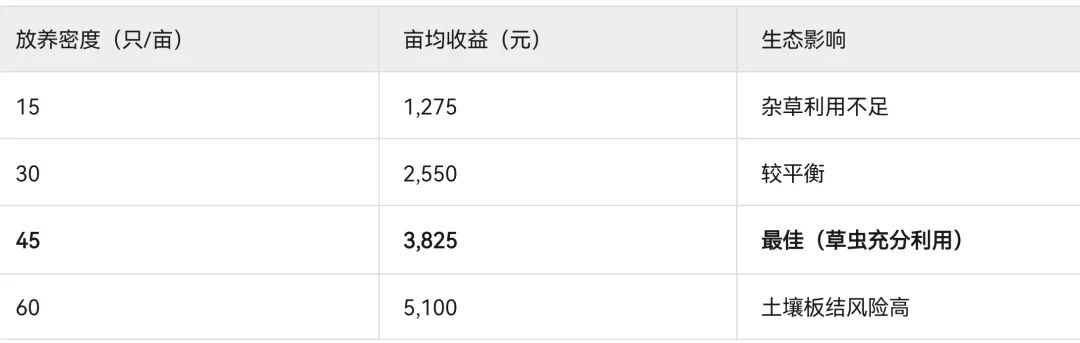
Broiler chickens reach market weight in 120 days, while laying hens take a full year; either way this is a short-cycle business line. Returns are not high, but with good management and the right tree species — ones not sensitive to damage from pecking and scratching — chickens can actually help tree growth, making this a dependable business line.
Understory beekeeping is a business line that demands fairly high management and technical skill. A single hive of ordinary Chinese honeybee yields about RMB 1,000 in profit; one mu can hold 12 to 15 hives, so annual profit can reach RMB 10,000. Beekeeping also requires planting nectar-source plants, and many nectar plants are themselves medicinal materials. Beekeeping therefore also brings income from medicinal herbs, and the presence of bees substantially raises the yield of those nectar and medicinal plants. Adding the herb income, annual returns can head toward RMB 20,000 per mu — quite respectable.
Understory raising also covers insects and forest livestock. Common insects include earthworm (Pheretima) and ground beetle (Eupolyphaga); forest livestock include sika deer and forest musk deer. Returns on these are considerable, and raising businesses generally have short cycles: earthworms and ground beetles are counted in days, while deer and musk deer reach sexual maturity in about two years. On the face of it, these all look like “big money” ventures.
So we cannot help asking: why is it that among the understory raising operators around us, so few actually make big money?
Let me offer a few reasons:
First, insufficient investment. Animals are not plants; they are sentient beings, more sensitive to environment, space, and even mood. Good raising therefore requires attentive care, which means better facilities and other infrastructure. Ordinary smallholder operations cannot afford large-scale infrastructure investment, so survival rates and growth conditions are naturally poor.
Second, inadequate processing capacity. The price gap between wild honey from the mountains and refined supermarket honey can reach several dozen times. Ordinary earthworm and ground beetle raisers do not know how to process and utilize their output, so when they sell raw material they are led by the nose by buyers. For large animals such as deer and musk deer, good profits require comprehensive processing and utilization of the whole animal and the conversion of specific parts into premium products — something ordinary farmers clearly cannot manage.
Over the past thirty years, in an era when the craft gap between rural workshops and urban deep-processing plants was not large, forest farmers, cooperatives, and small township enterprises could hold a certain command over final market pricing, capturing part of the processing profit along the industry chain (because at that time the market placed few demands on processing craft, and downstream retailers were happy to let forest farmers do rough on-site processing, stick on a label, and send the goods straight to market). For example, I used to pick ginseng myself at the Jilin ginseng market, slice it, choose a few nice boxes on the spot, pack it with a “premium tonic” label, and give it away as a gift — and it looked quite good. Yet as the times have moved on to the present day, the competitive landscape and logic of health-and-wellness products in the consumer market are no longer like that. More deep-processed products and finely crafted IPs have rushed in with capital behind them, and they generally have their own modern factories. Traditional forest farmer cooperatives have consequently lost the ecological position they once held in the reprocessing chain, retreating to supplying raw materials for primary production alone and losing their say over higher-profit segments. So no matter how valuable a product may be, primary producers struggle to make money from it.
This digression may seem to have little to do with the theme of this section, but it points to two problems. First, only investors who cover the entire industry chain can truly do the understory economy well; cultivation and raising alone can hardly earn sufficient profit. Second, a new mechanism must replace the traditional models of the past — rural cooperatives, contract farming, and the like — and it must be a linking-farmers, benefiting-farmers mechanism better suited to a modern market economy and modern business models. I will discuss that mechanism in a later chapter.
Let us summarize the understory raising business lines. Raising food poultry such as chickens, ducks, and geese offers modest but fairly stable returns. Raising operations aimed at medicinal use are inherently more profitable. But looking to the direction of future development, this is no longer something a single smallholder economy can sustain: it requires modern, large-scale capital invested across the entire industry chain.
Let us turn now to the understory cultivation field: understory vegetables, understory fungi, and understory medicinal plants. The first two are both short-cycle business lines; the third deserves a section of its own.
Understory vegetables: these are mainly wild mountain vegetables, which face a hard freshness deadline, and taste preferences are also a factor, so understory vegetables are mainly oriented to local markets. Because consumption is largely local, returns in this business line are bound to be modest.
Understory fungi: these divide into edible and medicinal fungi. The latter can achieve very high returns per mu, but they place heavy demands on downstream channel sales, and the upfront cost and technical requirements on the growing side are also high.
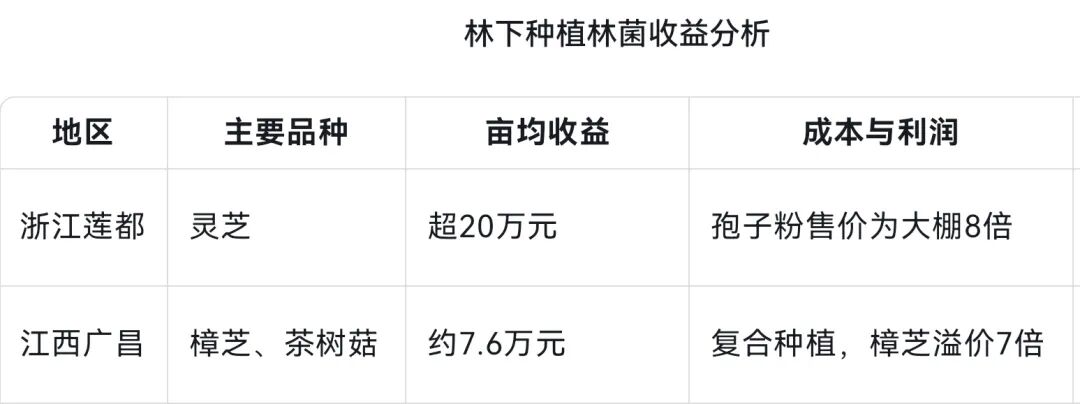
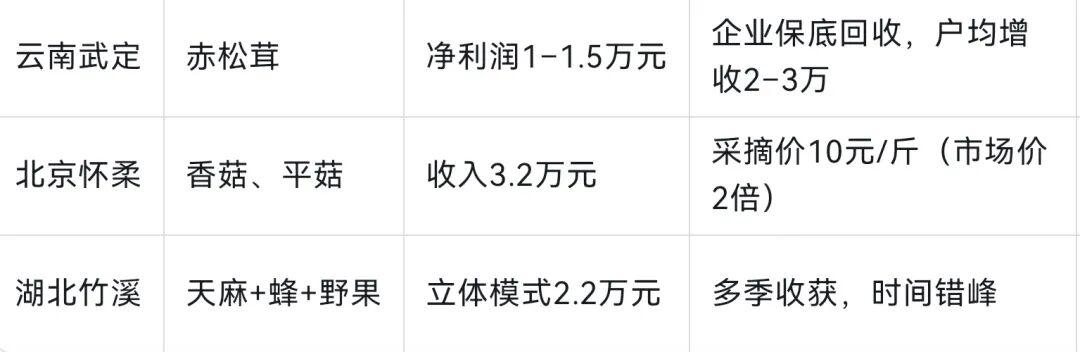
Understory fungi look extremely profitable, but actually going into the business means facing many risks. First, high returns come with high investment — tens of thousands of yuan per mu. That alone shuts out most smallholders. Second, there is management risk. Take reishi, the most profitable of all: good strains suitable for wild-simulated understory cultivation must be domesticated and bred; suitable mushroom-wood logs (bed logs) are required and must undergo sterilization and other treatment; the spore powder must be collected (because fresh mushrooms are not worth much); and the spore powder must then undergo cell-wall-breaking processing and transport. If any one of these steps is mishandled, an investment of tens of thousands of yuan per mu goes down the drain.
So from the high-return understory business lines we can see the same logic I described in the section on raising animals: modern (high-tech), large-scale capital, across the entire industry chain.
Understory medicinal plants: a topic very much worth discussing, and one with a certain social sensitivity. Mention understory medicinal plants and people think of wild-simulated cultivation of Chinese medicinal materials in the forest — most commonly the major shade-loving species such as Huangjing (Polygonatum), Baixianpi (Dictamnus bark), Fangfeng (Saposhnikovia), Pingbei (Fritillaria ussuriensis), Siberian ginseng (Eleutherococcus senticosus), and ginseng. But let me raise a controversial point: of all the wild-simulated understory medicinal plant cultivation going on so vigorously across the country, how much has actually succeeded and made money? Very little. The reasons are as follows:
-
The great majority of understory Chinese medicinal materials are not short-cycle business lines. Plant physiology dictates that shade-loving plants which cannot take in large amounts of photosynthesis must grow slowly. Common understory medicinal species generally need four or five years or more before harvest begins; Baixianpi and understory ginseng take more than ten years. The longer the cycle, the greater the investment risk — especially in a business of raising a living thing, where growth involves so many factors that a single misstep means failure.
-
Yields of understory medicinal materials are far below those on cultivated land. Because of the “effective-land ratio,” the medicinal output of one mu of forest land is generally one-third that of cultivated land. That means management costs are far higher than for growing medicinal plants on farmland.
-
Cultivation and tending costs on forest land are higher than on cultivated land. Forest land is not a single flat, level plane like farmland (though in some open woodland on the great plains of high-latitude regions, site conditions are not so different from farmland). Terrain, slope, vegetation, and other factors make mechanized operations impossible, so the cost of planting and tending medicinal plants in forest land is far higher than on farmland.
-
In today’s circulation market for Chinese medicinal materials, the principle that premium quality commands a premium price has not truly taken hold for many varieties. High-cost inputs do not recover equivalent high returns. For some varieties a significant price gap does exist — Panax notoginseng and ginseng, for instance, show a large gap between understory and farmland products. But market demand for high-end products is insufficient: pharmaceutical factories use raw material for production or extraction that offers the best cost-performance, and this does not affect the final efficacy of the medicine or health product (since what is extracted is the active ingredient).
So purely from the standpoint of investment return, traditional understory cultivation of Chinese medicinal materials is not a very good choice. This conclusion is of course controversial, and it runs against the academic conviction now current that Chinese medicine will perish at the hands of its medicinal materials. Solving the problem depends on the Chinese medicine industry building, starting from the market end, a tiered-pricing traceability and certification system for premium Chinese medicinal materials. Only when the market end recognizes the high value that corresponds to premium medicinal materials can the growing end generate enough profit to support investment in the understory and Chinese medicinal materials industry.
Yet understory medicinal plants are by no means limited to Chinese medicinal materials. In fact, traditional Chinese medicinal materials — or medicinal plant use based on the logic of Chinese medicine — account for only a small part of them. I have said on various occasions that the forest is the Earth’s largest natural pharmacy (the other being the ocean, which does not compare with the forest). Humanity came out of the forest, and the forest naturally holds every kind of wonder drug for safeguarding human health.
Let us first establish a basic concept: all plants and animals have medicinal value. On that basis, the understory economy has a great many paths it can take in cultivating understory medicinal plants.
The first line of thinking is protein. Protein is a fundamental element of human function, and China has long been short of high-quality protein. Plant protein is far superior to animal protein where health is concerned (plant protein is markedly better than animal protein for extending healthy lifespan, preventing chronic disease, and protecting the environment; animal protein is irreplaceable for supplying essential amino acids and for bioavailability, but it is a major cause of inflammation).
Protein supply comes mainly from herbaceous plants in the understory economy, because herbaceous plants have a far higher protein content than arbor trees.
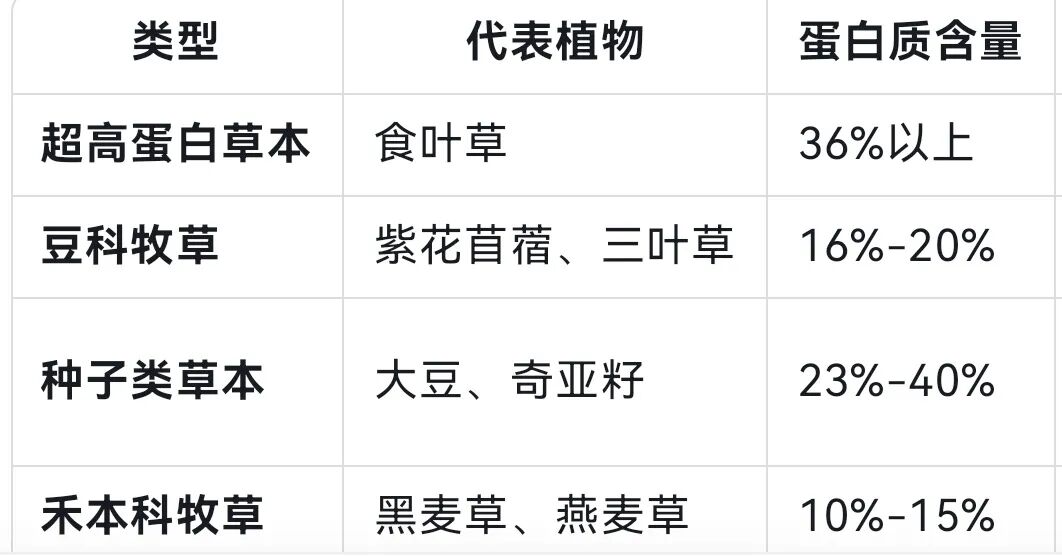
Herbaceous plants are characterized by fast growth, short cycles, high yields, and low cultivation and tending costs; downstream product conversion is not difficult, and they require no pharmaceutical regulatory approval.
Take protein grass (Shiyecao) as an example: cultivation costs about RMB 3,000 per mu per year, it can be harvested in two months, and protein extraction and SOD enzyme extraction can yield tens of thousands of yuan per mu per year.
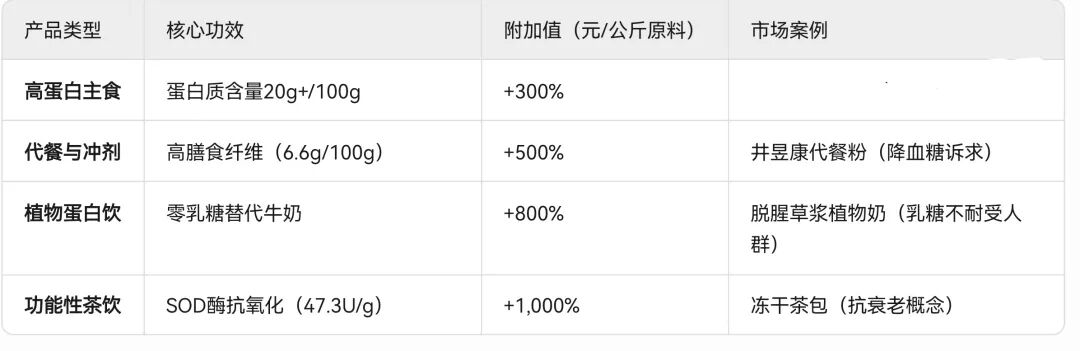
At the same time, protein grass is an excellent soil conditioner: the fresh grass left after extraction can be returned to the soil and effectively raises soil fertility. Protein grass can therefore be rotated with the medium-cycle medicinal plants described above, forming a “short-to-medium-cycle relay” and serving as a fast-adjusting crop for the rotational rest and rotation of medicinal plants.
Open your thinking, and there are many more choices among understory medicinal plants.
The second line of thinking is miscellaneous shrubs and wild grasses. In seeking out special medicinal plants, there are in fact biological patterns and techniques we can follow. The active ingredients we commonly need are flavonoids, saponins, sterols, and similar substances; next come certain specific proteins. The most common “specific proteins” are toxic substances — in theory, the more toxic a natural substance, the more likely it contains valuable specific proteins. Consider why plants evolved these toxic compounds: to defend against natural attack. Most medicinal ingredients derive from the secondary metabolites plants produce in resisting natural attack (environmental stress).
Following this pattern, we can understand why good medicine comes from cliffs and precipices, from places of wind, snow, and bitter cold. Following this pattern, we can also recognize that plants we take for granted by the roadside, growing stubbornly in harsh environments, often carry high-quality compounds in their very bones.
Take an example I often cite: cocklebur fruit (Xanthium sibiricum). Boys probably all played with it as children. It is everywhere along the roadside, indifferent to its environment, growing wild — and it took considerable effort for it to evolve into the form it has.
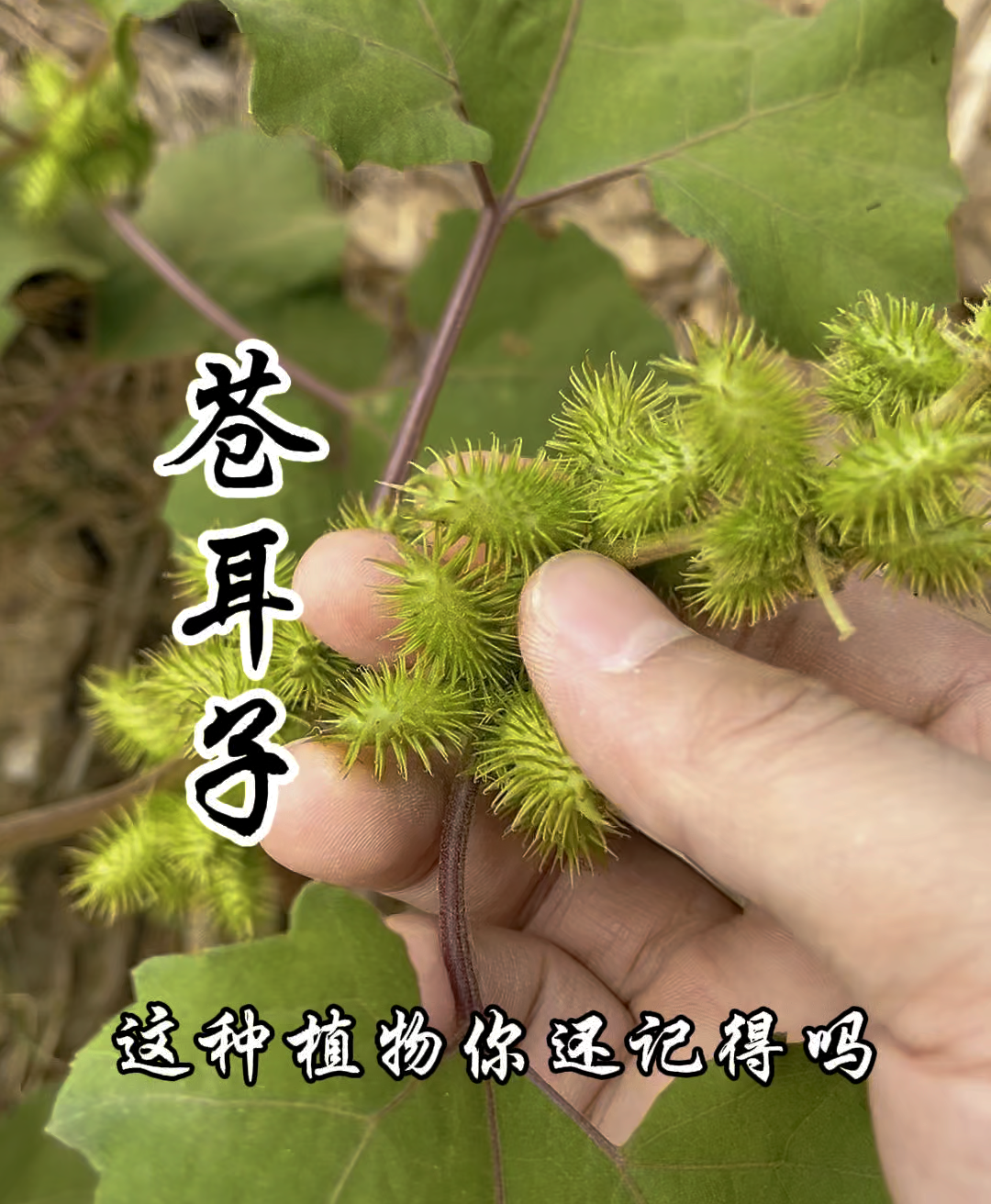
Cocklebur is very cheap to grow (it is by nature a king of weeds that needs no care), and it fruits and can be harvested in half a year. In traditional Chinese medicine it is famous for treating rhinitis. Yet because its track within traditional Chinese medicine is not a high-value one, and because it is itself somewhat toxic, it has not been used very widely in the past.
Modern biological analysis by our medical school has isolated a special active compound from cocklebur, “carboxyatractyloside.” What does it do? Everyone will like the answer: it promotes and stimulates human skin fibroblasts to produce collagen. Unlike substances that supplement collagen from outside, this is the real internal work that makes your body produce collagen itself. It also has strong skin anti-inflammatory effects.
So if it is combined with externally supplementing collagen ingredients to create a collagen skincare product that works both inside and out while also fighting skin inflammation, the profit margin would be very high indeed.
The understory economy also has some less well-known models, such as using modern biotechnology to compost and ferment under the canopy and produce high-quality biofertilizer. This can combine with the understory chicken raising described above: chicken manure as the raw material, natural forest litter such as leaves and branches, plus probiotics (such as EM) for fermentation. Composting in the understory space costs less than RMB 200 per cubic meter and produces fertilizer worth more than RMB 500, a resource conversion rate above 80% — returns comparable to gold.
Similar products in the forest are myriad — a thousand forms, endless variety. In the course of several billion years of evolution, the Earth long ago laid up for us a rich and varied treasury of medicine and health; for reasons of space I will not list them one by one.

From these cases we can see that, with open thinking, understory short-cycle business lines can be done brilliantly, and they are a perfect complement to the long-cycle timber business. But from these same cases we also see that realizing their true value cannot be achieved by growing a single crop and selling raw material.
*Common bulk products (such as Huangjing), where ordinary growers have no pricing power and are squeezed by middlemen
*Uncommon products (such as protein grass), where it is not easy for ordinary growers to find those niche buyers
*High-value-added products (such as reishi), where investment is too large and investment risk too high — one misstep and you lose everything
*Innovative products (such as cocklebur), where if you do not do the research and conversion yourself, nobody on the market will.
So understory economy practitioners today are largely stuck in an awkward predicament: the cases that do well are almost all run by people who have both financial strength and downstream product development and deep-processing capability.
So we can see that the understory economy — indeed, integrated forestry development and operation as a whole — is shifting toward modernization (high technology), large-scale capital, and the entire industry chain.
Having spent a great deal of space listing cases of cultivation and raising in the understory economy, let me close with a brief discussion of the understory economy’s “cocktail” investment return model.
Why is it called the “cocktail” model? Because it requires mixing, not a single ingredient.
First, an overly single business line carries the risk of total collapse unless you are absolutely certain of success, whereas mixing multiple businesses hedges that risk. Moreover, if what you hold is a fairly large tract of forest land (the single tracts we hold, for example, are generally tens of thousands of mu or more), a single business line often cannot fill the understory space of the entire tract.
Second, you need to build a cross-combination of “short-short cycle” or “short-to-medium cycle” pairings.
For example, first plant or raise ultra-short varieties of six months or less, and once that generates fairly rapid cash flow, begin investing in sub-short-cycle products of about 18 months; then, supported by the healthy cash flow of those two, invest in medium-cycle (within five years) high-value-added products or even longer-cycle products (five to ten years).
In other words, a good business model cannot accept producing no cash flow recovery within 24 months of investment. This was precisely forestry’s old weakness. The understory economy gives forestry a breakthrough: the ability to generate continuous cash flow on a 12-month cycle, or even a 6-month cycle, thereby sustaining long-cycle management that lasts for decades.
So build a 6-month layer, then insert an 18-month layer, then a 3-to-5-year layer, and combine them with long-cycle forestry business lines of five years or more: that is the cocktail model, and it is an extremely important contribution the understory economy makes to comprehensive, three-dimensional development of forest resources.