Full-Scope FSC Certification Drives Global Circulation of Forest Products
Perpetual Forest Management Series · Part Eight
F08 Full-Scope FSC Certification Drives Global Circulation of Forest Products
Getting a ticket to the world’s high-premium markets
By Xu Li | WeChat Official Account: Foreststellar
In several earlier articles I have repeatedly made one point: to maximize the returns from a forest, you must eventually go global. The reason is simple — China is one of the world’s largest markets for forest products, but it is also a major importer of them. If your forest products can only churn through cutthroat competition in the local market, you will forever be at the mercy of regional supply, demand, and price swings. But once your products hold a passport into the global market, your customers are no longer a handful of timber traders nearby — they are global giants like IKEA, Home Depot, and even Apple.
That passport is FSC certification.
1. What Is FSC, and Why Is It a “Global Boarding Pass”?
The FSC (Forest Stewardship Council) was founded in 1993 and is headquartered in Bonn, Germany. It is the world’s most authoritative and most rigorous forest sustainable management certification system. As of 2025, the FSC has certified more than 230 million hectares of forest in over 80 countries, making it the broadest-reaching and most widely recognized forest certification standard in the world today.
Put simply, an FSC label means that the wood used in a product comes from a responsibly managed forest — no reckless logging, no destruction of biodiversity, no infringement of indigenous peoples’ rights, no genetically modified tree species, and no conversion of natural forest into plantation.
In developed markets such as Europe and North America, FSC certification is no longer a bonus point; it is a threshold for market entry.
IKEA has committed to using 100% FSC-certified or recycled wood in all its wood products, and more than 98% of the wood it sources globally is now FSC-certified. All of Apple’s product packaging paper comes 100% from FSC-certified forests or recycled sources. North American building-materials giants such as Home Depot and Lowe’s all apply FSC-first procurement policies. The EU’s Deforestation Regulation (EUDR) took effect in June 2023, requiring all forest products entering the EU market to provide a due diligence statement proving that their supply chains do not involve deforestation after December 31, 2020 — and FSC certification is the most direct and most efficient route to EUDR compliance.
Penetration of FSC-certified forest products varies enormously across major global markets: over 85% in the Nordic countries (Sweden, Finland), roughly 55%–70% in Western Europe (Germany, the UK, France), about 45%–60% in North America (the United States, Canada), about 50% in Japan — and only about 22% in China today.
The gap is the opportunity. Whoever completes full-scope FSC certification first is first to hold a ticket to the world’s high-premium markets.
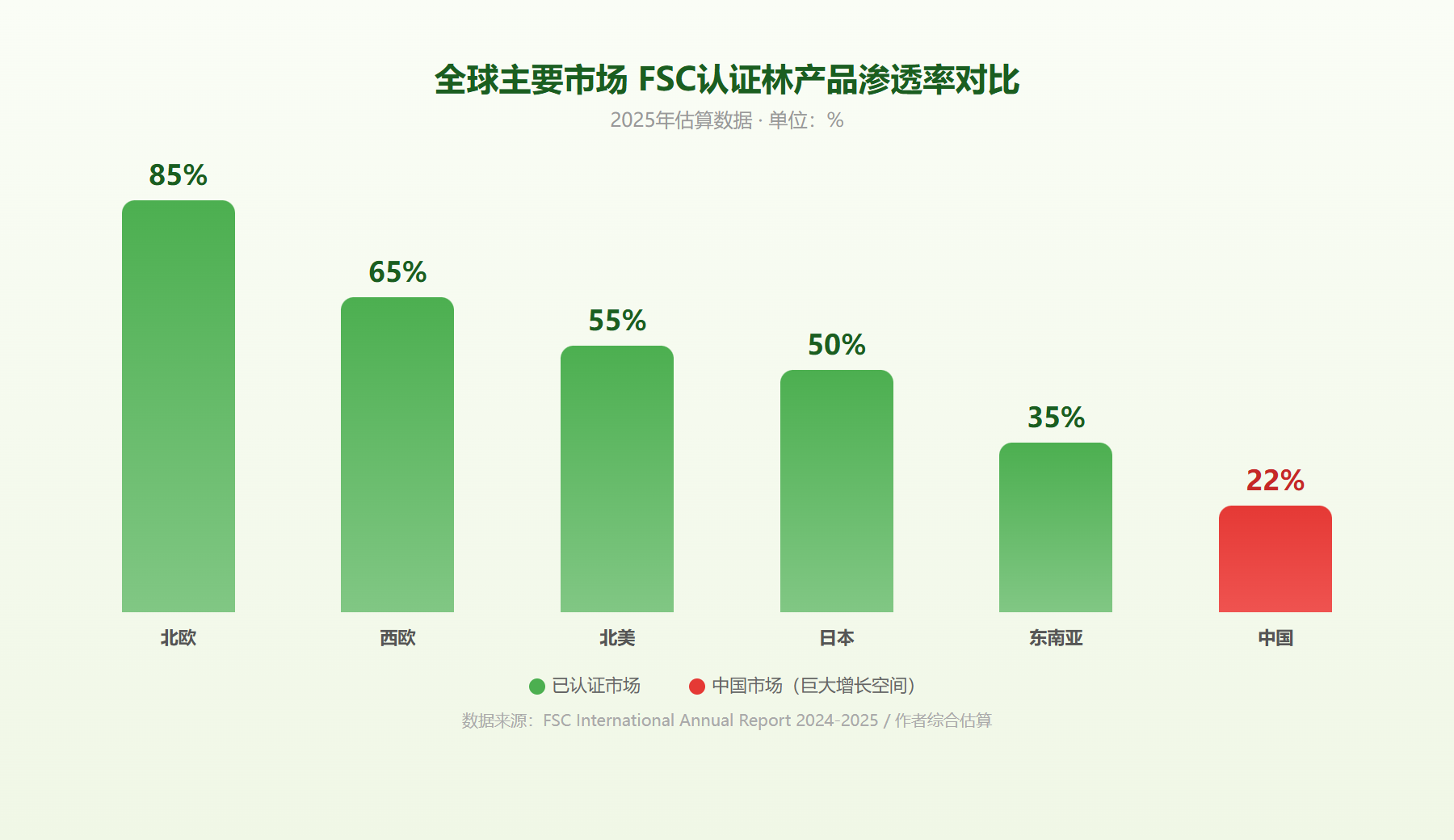
▲ Penetration of FSC-certified forest products in major markets (2025 estimate)
2. The Triple Value of FSC Certification: Premium Passport + Management Talisman + Capital Accelerator
Many people understand FSC certification as nothing more than an admission ticket for export trade. That view is far too narrow. For a forestry operator, FSC certification carries at least three levels of escalating value.
Level One: Market Premium — Real Money You Can See
FSC-certified forest products typically command a 10%–30% price premium in international markets. Take Chinese fir logs: in 2024, ordinary Chinese fir logs delivered to a mill in China cost about RMB 750–850 per cubic meter, while FSC-certified Chinese fir logs exported to Europe reached an FOB price of RMB 950–1,100 per cubic meter. On 100,000 mu of forest land with an annual harvest of 50,000 cubic meters, the certification premium alone adds more than RMB 10 million in extra revenue every year. If you take the deep-processing route — FSC-certified plywood or solid wood furniture, for example — the premium is even larger, reaching 30%–50%.
Level Two: Forcing Standardization of Operations — A Free External Auditor
FSC certification comes with an extremely rigorous set of management standards: ten principles and more than seventy criteria, covering everything from afforestation planning, harvest quotas, chemical control, and biodiversity protection to labor rights, indigenous peoples’ relations, community development, and the identification and maintenance of High Conservation Values (HCV). Many forestry companies find these standards suffocatingly cumbersome at first, but after a year or so of genuinely operating to FSC standards they marvel that their management capability has risen to a whole new level.
FSC certification is like a free external auditor: it forces you to do what should be done, record all the data that should be recorded, and keep every rule that should be kept. The management dividend that this standardization delivers — better supply-chain traceability, optimized production efficiency, lower compliance risk, stronger worker safety awareness — is worth far more over the long run than the cost of certification itself.
Level Three: Brand Value and Capital Recognition — Hard Currency in the ESG Era
A forestry company with FSC certification naturally attracts ESG investors in international capital markets. In the product design for forest asset securitization (which we discuss in detail in F09–F10), FSC certification is one of the most central credit-enhancement instruments — it sends investors an extremely clear signal: this forest is managed sustainably, and your investment will not blow up because of an environmental scandal.
With ESG investment now surpassing USD 40 trillion, an FSC certificate is a letter of credit for entry into the global pool of green capital.
3. “Full-Scope FSC Certification”: Turning a County into a Major International Forest-Product Base
This is the core innovation of this article. Through years of FSC certification practice, my company, Zhongsen Ecology, has gradually worked out a new “full-scope FSC certification” model that differs from the traditional approach of certifying one tract of forest land at a time: take a county — or even a prefecture-level city — as the unit, plan and coordinate the management of all state-owned forest farms, collective forest land, and National Reserve Forest projects across the whole area, and pass FSC Forest Management (FM) certification for the entire area in a single exercise, so that the whole county becomes an identifiable, trustworthy “single major forest-product base” in international markets.
3.1 Why “Full Scope”?
The traditional FSC certification model is “one company, one forest, one certificate” — a company takes its own tens of thousands of mu of forest land to a certification body for audit and certification. The drawbacks of this model are obvious:
First, diseconomies of scale. Certification audit fees are not linear in area, so the marginal cost of certifying a single small tract is extremely high. An initial FSC FM audit typically costs RMB 150,000–300,000 (depending on area and complexity), with annual surveillance audits at RMB 80,000–150,000. For a company with only 30,000–50,000 mu of forest land, certification costs can absorb a substantial share of annual profit.
Second, a weak brand effect. A scattered certified forest area of a few tens of thousands of mu has little recognition in international markets, and buyers cannot identify it as an independent, stable supply base.
Third, fragmented management. Certifying separately means separate management systems, monitoring systems, and traceability systems that are isolated from one another, unable to share data, and unable to build supply-chain capability at scale.
The core logic of full-scope FSC certification is this: turn the “county” into a brand. Just as Bordeaux stands for wine and Jingdezhen for porcelain, we want full-scope certification to plant a brand perception in international buyers’ minds: “Lechang = a base for premium FSC-certified forest products.” When a county appears in the FSC international database as a “full-scope” entity, its market appeal and bargaining power change qualitatively.
3.2 How Full-Scope FSC Certification Works: Model and Process
Drawing on our practical experience with more than 10 million mu of FSC-certified or pre-certified forest land, the full-scope FSC certification workflow can be summarized as five steps:
Step one: full-scope resource survey and preparation of a management plan (2–4 months). Led by the county forestry authority, a professional firm is commissioned to carry out a comprehensive survey of all forest resources in the area — forest land tenure, stand types, age-class structure, growing stock, biodiversity baseline, identification of High Conservation Value areas, and community distribution and indigenous rights. On that basis, a “Full-Scope Sustainable Forest Management Plan” is prepared; this document becomes the core reference for the FSC audit.
Step two: management system and capacity building (3–6 months). Establish an FSC management system covering the whole area, including: forming a “Full-Scope Forest Management Committee” (with government, companies, forest farmers, and communities all represented), developing environmental and social impact assessment procedures, establishing a chemical control list and application protocols, improving occupational safety and health systems, setting up a complaints and dispute resolution mechanism, and building a forest monitoring and data management system. The core task at this stage is “build the rules, build the team, train the people” — we typically need to produce more than 30 institutional documents and run at least five rounds of front-line staff training.
Step three: stakeholder consultation and community participation (1–2 months). A key FSC requirement is “full stakeholder participation.” Full-scope certification involves a far wider range of interested parties than a single-company certification — it must cover forest farmer cooperatives across the county, neighboring villagers, indigenous communities (if any), local environmental organizations, and downstream processing companies. We usually combine four methods — public notices, roundtable meetings, household interviews, and questionnaires — to ensure every stakeholder’s right to be informed and to participate. This step is often the most demanding of energy, but it is also where FSC certification’s social value shows most clearly.
Step four: pre-assessment and gap analysis (1–2 months). Before the formal audit, an FSC-accredited certification body (such as SGS, Bureau Veritas, SAI Global, or Control Union) is invited to conduct a pre-assessment, identify the gaps between the management system and actual practice, and draw up a corrective action plan. The value of the pre-assessment is “clearing the mines in advance” — many first-time certification failures stem from underestimating certain hard requirements, such as the depth of the High Conservation Value assessment or the procedural completeness of Free, Prior and Informed Consent (FPIC) with indigenous peoples.
Step five: formal audit and certification (1–2 months). The certification body sends an audit team (usually 3–5 people, depending on area) for an on-site audit lasting 5–10 days, including document review, field inspection of forest land, community interviews, and worker interviews. On passing, an FSC FM (Forest Management) certificate is issued, valid for five years, with one surveillance audit each year.
For a county, full-scope FSC certification usually takes 12–18 months from launch to certificate, at a total cost (including consulting fees, audit fees, and internal capacity-building investment) of roughly RMB 800,000–1.5 million — spread across hundreds of thousands or even a million mu of forest land in the county, that is only RMB 1–3 per mu.
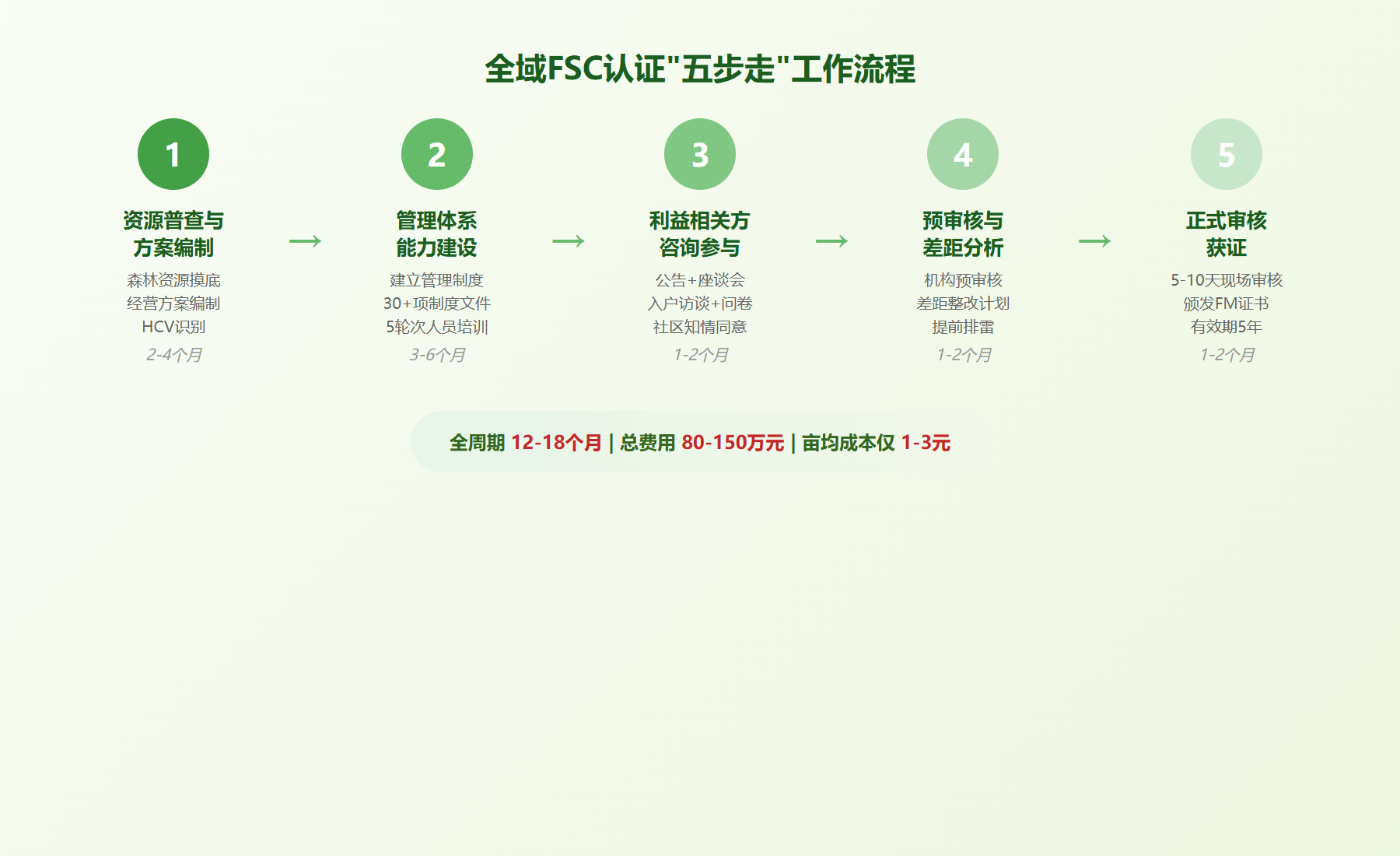
▲ The five-step full-scope FSC certification workflow
3.3 Likely Obstacles and Solutions
In advancing full-scope FSC certification, there are five obstacles we encounter most often and must confront and resolve:
Obstacle one: complex forest land tenure. Forest land tenure in rural China spans state-owned, collective, and individually contracted forms, and determining the certification entity under the “separation of three rights” (ownership, contracting rights, and management rights) is a major challenge. Solution: adopt a Group Certification model — a management entity with legal personality (such as a county-level forestry investment platform company) applies for certification as the “group manager,” and the various scattered forest rights holders are brought in as “group members” under that management. The FSC has a dedicated standard for Small and Low Intensity Managed Forests (SLIMF), which greatly simplifies certification procedures for collective and individually owned forests.
Obstacle two: chemical control. The FSC places extremely strict limits on pesticide and chemical use — highly toxic pesticides are banned, a chemical “whitelist” system is required, and the type, dose, timing, and location of every application must be recorded. Some forest regions in China have a long-standing habit of relying on chemical weeding, which is difficult to change. Solution: promote mechanical weeding (brush cutters) and biological control alternatives; set a 3–6 month transition period to phase out prohibited chemicals; and incorporate chemical control into the performance appraisal of forest farm managers. In practice we have found that although mechanical weeding raises short-term labor costs by about 15%, over the long run it reduces soil compaction and the risk of chemical damage, for a net positive benefit.
Obstacle three: identifying and maintaining High Conservation Values (HCV). The FSC requires an HCV assessment of all certified forest land — identifying areas of high conservation value (such as habitats of rare species, water-conservation areas, and cultural heritage sites) and drawing up dedicated protection measures. This places high demands on technical capability and data foundations. Solution: use “space-air-ground integrated” monitoring technology (the AI large-model plus remote sensing plus drone solution detailed in F11), combined with years of biodiversity survey data from local forestry authorities, to complete HCV assessments quickly. Today we can already automatically identify water-conservation areas and the distribution of rare vegetation communities from satellite imagery, cutting the initial HCV screening time from the months it traditionally takes to a few weeks.
Obstacle four: forest farmers’ acceptance and willingness to participate. For ordinary forest farmers, FSC certification is a completely unfamiliar concept that requires filling in forms, following rules, and submitting to inspections — “extra burdens” that can provoke resistance. Solution: the key is to “let forest farmers see the benefit.” We designed a certification premium-sharing mechanism that returns part of the timber premium generated by FSC certification to forest farmers (for example, 30%–50% of the premium goes to the farmers), making certification a tool for increasing their income rather than a task handed down from above. At the same time, we train in plain language instead of professional jargon, replacing “arguments people half understand” with “money they can see.”
Obstacle five: the cost of maintaining certification and managing the five-year cycle. An FSC certificate is valid for five years and requires annual surveillance audits, so the ongoing management and maintenance costs cannot be ignored. Some projects slacken off once the certificate is in hand, then fail their annual surveillance audit and have the certificate suspended or withdrawn. Solution: build a “certification health dashboard” that quantifies the indicators under the FSC’s ten principles into monitorable KPIs and incorporates them into monthly management reports. Create a dedicated “certification compliance officer” role responsible for day-to-day oversight and preparing the annual audit. We are also developing an AI-based “FSC compliance assistant” that automatically flags upcoming corrective actions and key annual audit milestones.
4. CFCC and FSC: The “Domestic License” and the “International License” for Chinese Forest Products
Whenever I talk about the FSC, someone asks: doesn’t China have its own forest certification system, the CFCC? Why bother with the FSC? It is a very good question, and it deserves a serious answer.
The CFCC (China Forest Certification Council) is a forest certification system China has built on its own, and in 2014 it formally gained mutual recognition from the Programme for the Endorsement of Forest Certification (PEFC). That means CFCC-certified forest products are recognized in the markets covered by the PEFC system, mainly parts of continental Europe and Asia.
But there is a key distinction here: CFCC/PEFC and FSC are two independent certification systems, and there is no mutual recognition between them. The PEFC system favors a bottom-up model in which each country sets standards suited to its own conditions and then recognizes the others, while the FSC uses a top-down model of globally uniform standards. The two differ fundamentally in philosophy.
An analogy: the CFCC is like a “domestic driver’s license,” usable in countries that recognize the PEFC; the FSC is like an “international driver’s license,” accepted almost everywhere in the world’s major developed markets. If your target market is mainly domestic or in PEFC-recognizing countries, the CFCC is perfectly adequate; but if your target is global procurement giants like IKEA, Apple, or Sam’s Club — they require FSC, with no room for negotiation.
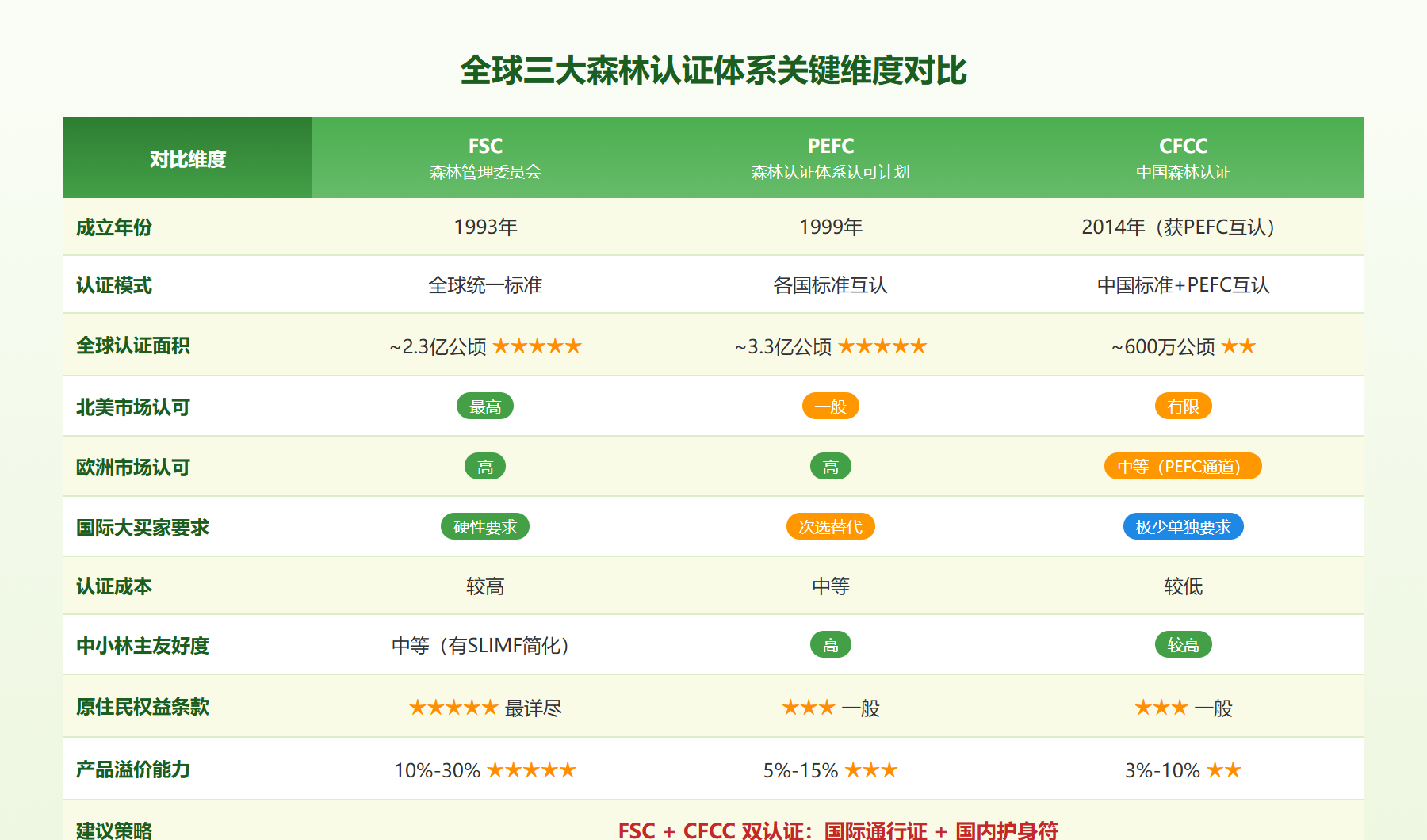
▲ Comparison of the world’s three major forest certification systems on key dimensions
4.1 A Panoramic Comparison of Global Forest Certification Systems
There are currently three mainstream forest certification systems worldwide: FSC; PEFC (including the national systems it recognizes, such as CFCC and SFI); and a number of regional or national certification systems (such as MTCC in Malaysia, CERFLOR in Brazil, and AFS in Australia).
FSC’s strengths: the highest global recognition (especially in North American and Nordic markets); the strictest standards (ten principles covering the environmental, social, and economic dimensions); a hard requirement of major international buyers (IKEA, Apple, Kimberly-Clark, Unilever, and others); and the most detailed provisions on indigenous peoples’ rights and High Conservation Values. FSC’s weaknesses: relatively high certification costs (especially for small-scale operators); inconsistent enforcement of the standards across regions; long audit cycles; and the view among some developing countries that its standards are too “Eurocentric.”
PEFC’s strengths: relatively lower certification costs; respect for national circumstances, allowing national standards to gain mutual recognition under the PEFC framework; greater friendliness to small and medium-sized forest land operators (80% of PEFC-certified forest land is managed by small-scale family forests); and high recognition in continental European markets. PEFC’s weaknesses: standards of uneven rigor (they depend on the quality of each country’s own standards); clearly lower recognition than FSC in North American and UK markets; in the procurement policies of major international buyers, PEFC generally serves only as a “second-choice alternative” to FSC; and some environmental NGOs criticize PEFC as “greenwash.”
The CFCC (China)‘s distinctive features: as China’s national system recognized by PEFC, its standards are designed to fit Chinese conditions more closely — for example, on “forest tenure” it takes full account of China’s collective forest tenure system and the reform separating the three rights; on “community relations” it incorporates the policy language of China’s poverty alleviation and rural revitalization; and on “chemical management” it aligns with China’s pesticide regulatory system. The CFCC’s limitations: limited international recognition (mainly through the PEFC channel); very few global buyers specifically require the CFCC; and CFCC-certified products command a noticeably weaker premium in international markets than FSC-certified products.
Our recommended strategy is dual certification: FSC plus CFCC. FSC secures the “international passport,” CFCC the “domestic talisman” — pursue both in parallel, at about 30%–40% higher cost, and your market coverage delivers a 1+1 greater than 2 effect.
5. Raw-Material Forests vs. Processing Chain: FSC Certification’s “Dual-Channel” Architecture in the Industry Chain
Many people do not know that FSC certification actually has two completely different tracks — FM (Forest Management certification) and CoC (Chain of Custody certification). Understanding the difference between them is the key to connecting the whole chain “from forest land to shelf.”
5.1 FM Certification: Managing the “First Mile” Well
FM certification applies to the forest itself — that is, to the forest land management unit. It certifies whether the management of that forest conforms to sustainable principles. The scope includes: whether afforestation follows the principle of matching species to site; whether harvest volume stays below growth; whether harvesting methods protect soil and water; whether seed trees and rare species are retained; whether endangered species habitats are protected; whether chemical use is controlled; whether worker safety is assured; and whether indigenous peoples’ and community rights are respected.
Put simply, FM certification governs how trees are planted, harvested, and protected. The full-scope FSC certification discussed above is simply FM certification advanced at scale.
5.2 CoC Certification: Managing “Every Mile” Well
CoC certification applies to the processing, trading, and distribution of forest products — from the moment a log leaves the mountain, through sawn timber, plywood, papermaking, furniture, and packaging. Every processing and transfer link that claims a product is “FSC-certified” must hold a CoC certificate.
The core mechanism of CoC is “mass balance”: for every batch of FSC-certified raw material entering a factory, there must be a corresponding output of FSC-certified product — the two ends must reconcile. Each year the certification body audits CoC-certified companies once, checking purchase documents, production records, inventory data, and shipping documents to verify the truth of the FSC claim.
5.3 The Seamless FM + CoC Connection: From Forest Land to the IKEA Shelf
Let us illustrate with a real product chain:
Link one — forest land (FM certification): the Chinese fir plantations under Lechang’s full-scope FSC certification are thinned in line with the management plan, and the FSC-certified logs produced carry the FSC 100% label.
Link two — sawmill (CoC certification): a wood processing company holding a CoC certificate buys the FSC-certified logs and processes them into FSC-certified sawn timber, with each batch accompanied by an FSC declaration and a CoC certificate number.
Link three — furniture factory (CoC certification): an IKEA supplier turns the FSC-certified sawn timber into shelves for the BILLY bookcase, using the FSC Mix label (a mix of FSC-certified wood and recycled material).
Link four — retail (CoC certification): when an IKEA store sells the BILLY bookcase, the packaging carries the FSC label, and consumers can scan a code to trace the wood back to its source.
Every link in this chain must hold a valid FSC certificate for the chain to hold together. If any link breaks — the sawmill lacks a CoC certificate, or the furniture factory’s mass balance records do not reconcile — the entire FSC claim is void. That is why major international buyers trust FSC certification so completely: it is not a “certificate of honor” but a tracking system with no gaps.
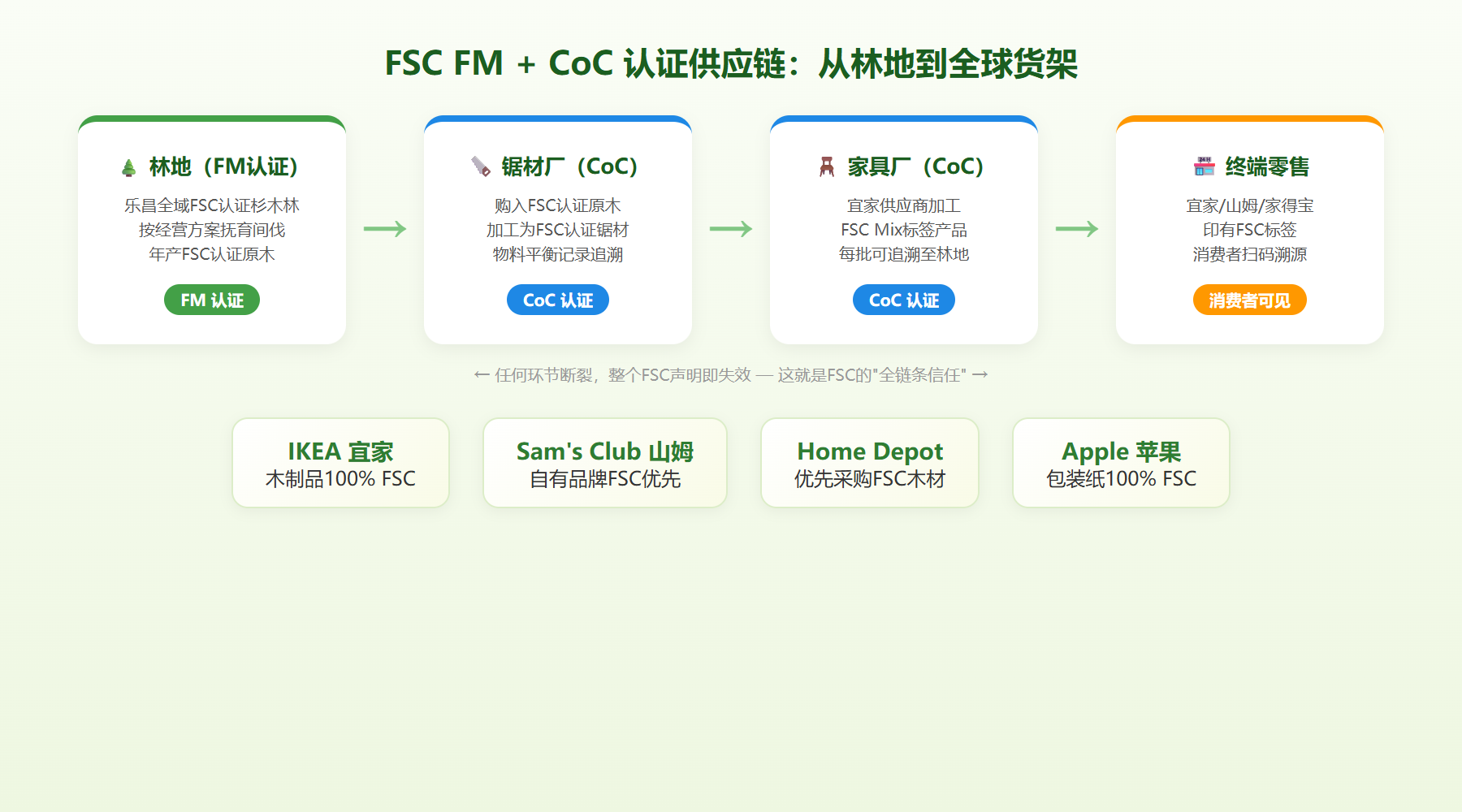
▲ FSC FM + CoC certification: the complete supply chain from forest land to major international buyers
6. Reaching Major International Buyers: From the Global Procurement List to a Lechang Supply Contract
The ultimate commercial value of full-scope FSC certification is that it plugs a county’s forest products directly into the procurement systems of major global buyers. Let us look in detail at what these buyers require:
IKEA: the world’s largest furniture retailer, purchasing about 20 million cubic meters of wood a year, with a target of 100% FSC-certified sourcing. IKEA’s core requirements for suppliers: (1) a stable holder of FSC FM/CoC certificates; (2) annual supply capacity above a minimum threshold (usually more than 5,000 cubic meters); (3) export qualifications and compliant customs clearance capability; and (4) acceptance of IKEA’s IWAY supplier code of conduct (covering labor, environmental protection, business ethics, and more).
Sam’s Club / Walmart: Walmart’s global procurement policy requires that by 2025, 100% of the wood in its private-label wood products come from FSC-certified or recycled sources. Sam’s Club stores and online platforms in China sell large volumes of wooden furniture, home goods, and paper products, and FSC certification has long been a mandatory item on its supplier audit checklist.
Kimberly-Clark and P&G: among the world’s largest tissue-paper companies, purchasing millions of tonnes of wood pulp a year, with FSC certification a core requirement of their “preferred fiber procurement policies.”
Apple and Google: the tech giants require FSC certification for product packaging paper and office paper. Although a single company’s wood consumption is smaller than that of a furniture giant, its “zero deforestation” commitment carries a powerful brand demonstration effect.
A county-level forest-product base that has completed full-scope FSC certification has, in effect, received a “pre-qualification notice” from all of these major buyers at once — what remains is price negotiation and logistics. That is the strategic significance of full-scope certification: it packages a county’s scattered forest land into a “super-supplier” that meets the world’s highest standards and can take orders directly from major international buyers.
7. The Lechang Forecast: The Economics of Full-Scope FSC Certification for a County-Level City
Let us take Lechang, a county-level city under Shaoguan in Guangdong Province, and make a rational, measured forecast of its economic contribution. Lechang is one of Guangdong’s key forestry counties, rich in forest resources, and one of the areas where Zhongsen Ecology works in depth.
7.1 Basic Data on Lechang’s Forest Resources
Lechang has a total area of 2,421 square kilometers, about 2.8 million mu (roughly 187,000 hectares) of forest land, a forest coverage rate of about 77%, and growing stock of more than 12 million cubic meters. Of this, about 1.8 million mu of commercial forest (including National Reserve Forest, state-owned forest farms, and collective commercial forest) can be brought within the scope of FSC certification. The main species are Chinese fir, masson pine, eucalyptus, bamboo, and native broadleaf species.
7.2 Forecast of Output Growth After Certification (Conservative–Baseline–Optimistic Scenarios)
Assume Lechang completes full-scope FSC FM certification (1.8 million mu certified) and, within three years, gradually builds a CoC certification network covering its main forest-product processing companies. We model three scenarios:
Conservative scenario (log export premium only): annual harvest after certification is about 300,000 cubic meters (based on 1.8 million mu at roughly 4 m³ per mu per year of growth and a reasonable harvest rate of about 40%). With a conservative 10% premium on FSC-certified logs and an average roadside price of RMB 750 per cubic meter, this adds about RMB 22.5 million in annual output value.
Baseline scenario (log plus primary processing premium): on top of the conservative scenario, about 40% of the logs (120,000 cubic meters) are processed locally (sawn timber, rotary-cut veneer, plywood), with a roughly 20% premium on FSC-certified processed products, adding about RMB 46.5 million in annual output value.
Optimistic scenario (deep processing across the whole industry chain plus direct sourcing by major international buyers): on top of the baseline scenario, attract 2–3 major international buyers (such as IKEA suppliers) to set up FSC CoC-certified processing bases in Lechang, with about 20% of the logs (60,000 cubic meters) going into deep processing (solid wood furniture, engineered wood products). With a 30%–50% premium on FSC-certified deep-processed products, this adds about RMB 72–95 million in annual output value.
7.3 Overall Contribution to Tax Revenue and the Local Economy
Beyond the direct premium income from forest products, full-scope FSC certification will contribute to Lechang’s economy through the following channels:
Investment pull in processing: the brand effect of an FSC-certified base is expected to attract RMB 300–500 million in wood processing and furniture manufacturing investment, driving growth in fixed-asset investment and tax revenue from construction services.
Employment and higher forest farmer incomes: certified forest-product processing and export trade are expected to create 2,000–3,000 new jobs, raising forest farmers’ per capita annual income by RMB 3,000–5,000 (from premium sharing and labor income).
Export earnings and tax revenue: under the baseline scenario, exports of FSC-certified forest products generate about USD 6–8 million in foreign exchange a year and directly contribute about RMB 8–12 million a year in value-added tax and corporate income tax.
Carbon sink trading premium: FSC-certified forest land provides a naturally high-quality foundation for developing carbon sink projects. At a CCER/VCS carbon price of RMB 40–80 per tonne of CO₂, 1.8 million mu of certified forest land yields an annual carbon sink increment of about 360,000 tonnes of CO₂ equivalent (estimated at 3 tonnes of CO₂ equivalent per hectare per year), worth about RMB 14.4–28.8 million a year.
Overall estimate: once Lechang completes full-scope FSC certification, within 3–5 years the forest-product industry’s total annual output value will rise by about RMB 80–150 million, annual tax contribution by about RMB 15–25 million, and annual export earnings by about USD 6–20 million, with 2,000–3,000 new jobs and RMB 3,000–5,000 more in per capita income for forest farmers. And this is only one industry’s contribution — add the brand spillover of FSC certification into ecotourism, forest wellness, and the understory economy, and the overall economic pull becomes even more considerable.
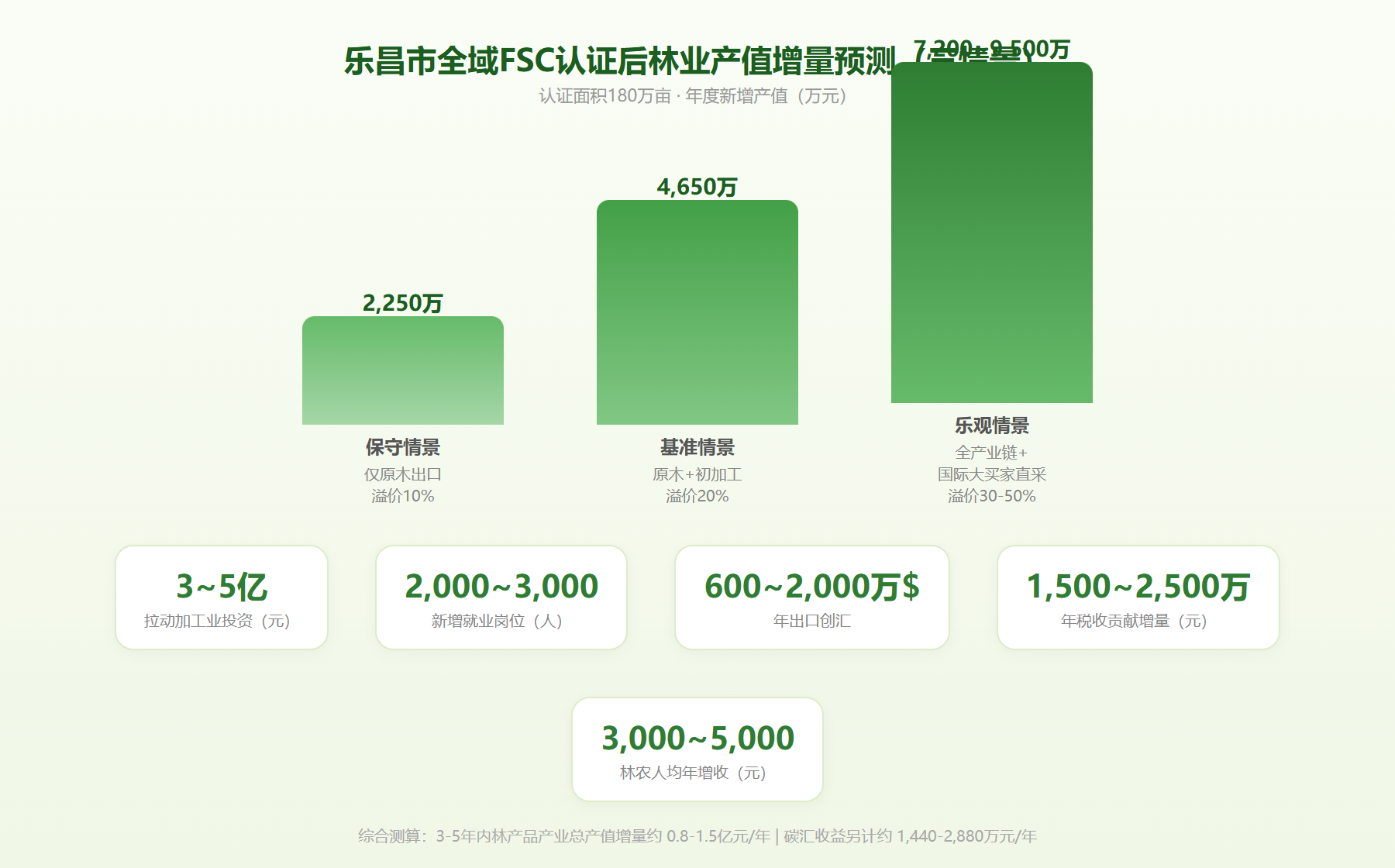
▲ Forecast of incremental forestry output value in Lechang after full-scope FSC certification (three-scenario comparison)
8. Beyond FSC: From Certification to a Voice in Global Forest Governance
Our vision goes beyond FSC certification itself. By advancing full-scope FSC certification, we hope to take a growing part in building the global forest governance system.
Today the voice in global forest governance rests mainly with European and American environmental NGOs and certification bodies. China, with the world’s largest area of planted forest (more than 80 million hectares), has a say in global forest governance that is badly out of proportion to its size. If we can bring the successful practices of China’s National Reserve Forest program — standardized planting, intensive management, the model of linking farmers and benefiting farmers, and integrated understory management — into the global standard system for sustainable forest management, that would be a tremendous contribution to global forestry governance.
We are now in dialogue with FSC International, the World Wide Fund for Nature (WWF), and other institutions, working to bring China’s perpetual forest management model — especially the National Reserve Forest program’s model of central-local coordination, linking farmers and benefiting farmers, and diversified operations — within the recognized scope of the global certification system. The road is long, but the direction is right.
When every forestry county in China can obtain full-scope FSC certification, when Chinese forest products move freely through global markets, and when forest products “made in Lechang” appear on the shelves of every IKEA store in the world — that will be not only the honor of one county but a milestone in Chinese forestry’s march onto the world stage.
Conclusion: FSC Is Not an End, but a Means
Finally, I want to stress one important point: FSC certification is not an end but a means.
Through FSC certification, our goal is not merely to sell products to Europe and America, but to build a perpetual forest management system that aligns with international practice and can withstand global scrutiny. The core value of full-scope FSC certification is that it upgrades a county’s forest resources from a “patch of forest” in the geographic sense to “a brand” in the sense of international trade.
When every forestry county in China has completed this kind of upgrade, and when Chinese forest products move freely through global markets, the global circulation of forest assets will truly become a reality. And when that day comes, the full-scope FSC certification we are discussing today will prove to have been a milestone strategic decision on the entire path of Chinese forestry’s internationalization.
“Getting a ticket to the world’s high-premium markets is never the finish line. The real voyage only begins the moment you step onto the deck.”
────────────────────────────────────
Next up: F09 Creating Stable, Fixed-Income Forest Financial Products — Making Forest Assets an Investment Ordinary People Can Sleep Soundly On
────────────────────────────────────
— Foreststellar · Perpetual Forest Management Series —