Exploring a Forest Asset Monetization System
*** *** ***
FOREST COIN
*** *** ***
F10 Exploring a Forest Asset Monetization System — From Stablecoins to a Forest Civilization of Human Symbiosis
Foreststellar · Xu Li
(Final installment of the Perpetual Forest Management Series · July 2026)
Introduction: Why I Wrote This Article
From F01 to F09 we used nine installments to start from the forest’s nature as a financial asset and travel all the way through liquidity engineering (quantum division and separation of income rights), the operating rhythm of short-long combination, technology-enabled high-value conversion, the circular leverage of policy-based finance, and full-scope FSC certification for global circulation — finally arriving at stable, fixed-income forest financial products. If I had to sum up that journey in one sentence, it would be this: everything we are doing is meant to make this forest — this “mountain of gold and silver” — something that can truly be priced, divided, traded, invested in, and financed.
But all of it still stayed at the level of “assets.” No matter how much an asset is securitized or converted into fixed income, it remains an “asset” — an object that has to be held and managed, a “subject matter” for the financial system rather than “infrastructure” of the financial system itself.
In this final installment, I want to take one more step forward. Not to turn the forest into a kind of asset, but to turn the forest into a kind of “currency” — no, something grander than currency. I want to make the forest the underlying anchor of human civilization, the infrastructure connecting Earth’s ecology with an interstellar future.
I know how arrogant that sounds. But let me finish the logic.
1. The Forest: The Only Biological Asset on Earth That Is “Renewable, Self-Sustaining, and Self-Growing”
1.1 The Historical Cycle of Monetary Anchors
The history of human money is, in essence, a history of searching for the “perfect anchor.”
Shells fail — too easy to obtain, no scarcity. Gold, silver, and copper work — scarce, divisible, verifiable — but they cannot grow: their stock is fixed, and economic expansion necessarily brings deflation. The Bretton Woods system anchored the dollar to gold and collapsed in 1971 — because gold could not grow fast enough to keep pace with global economic expansion. After that came the era of pure fiat currency, and the anchor became “national credit” and “expectations of economic growth” — but credit can default, and expectations can collapse.
In the cryptocurrency era, people tried to anchor value with algorithms and mathematics. Bitcoin anchors itself through “computational power consumption” and a “constant total supply of 21 million coins” — but a constant total supply means it is essentially imitating gold’s logic of scarcity, and its deflationary character makes it better suited to being “digital gold” (a store of value) than a “digital currency” for daily circulation (a medium of exchange). Stablecoins anchor to fiat reserves — but that merely moves the anchor from fiat currency to the national credit behind it; it does not solve the fundamental problem.
So an ideal monetary anchor has to satisfy three seemingly contradictory conditions at the same time:
First, scarcity — it cannot be obtainable at will, or it cannot carry value.
Second, growth — it must be able to grow along with the economy, or deflation is inevitable.
Third, credibility — its existence and its value growth must be objective, verifiable, and tamper-proof.
Gold satisfies scarcity and credibility, but not growth. Fiat currency satisfies growth, but not scarcity (it can be over-issued) or credibility (credit can collapse). Bitcoin satisfies scarcity and credibility, but not growth. These three conditions look unsolvable — until we look at the forest.
Figure 1 | The historical cycle of monetary anchors: from shells and silver to gold to sovereign credit — and the next one may return to the “forest standard”
1.2 Why the Forest Is the Only Answer
The forest is the only biological asset on Earth that satisfies all three attributes at once: renewable, self-sustaining, and self-growing. And these three points correspond exactly to the three necessary conditions for a monetary anchor.
Renewable corresponds to “sustainability within scarcity.” A forest is not a non-renewable resource — a mine is gone once it is dug out, oil is exhausted once it is pumped dry — but a forest can produce in perpetuity under sound management. Its scarcity is not the scarcity of a “fixed total quantity” but the scarcity of a “growth cycle”: plant a tree today and it will not be timber tomorrow, and that is a natural constraint on growth. This “time-constrained renewable scarcity” is a better monetary anchor than gold’s “absolute scarcity” — because it both prevents over-issuance (you cannot conjure a forest out of thin air) and grows naturally over time (trees keep growing).
Self-sustaining corresponds to “credibility.” A forest, as long as you do not destroy it, maintains its own ecosystem — photosynthesis, the water cycle, soil formation, seed dispersal, the natural balance of pests and disease. You do not need to maintain it the way you maintain an office building, or guard it the way you guard a gold vault — it is “living on its own.” This self-sustaining quality means that the forest’s existence and its value growth depend on no one’s promise, no institution’s credit, no nation’s endorsement — it is self-evident in nature.
Self-growing corresponds to “growth.” This is the most fundamental feature that sets the forest apart from every other natural resource on Earth. Oil does not multiply itself, gold does not enlarge itself, land does not appreciate itself — but a forest does. Even if you “do nothing at all,” a tree still grows taller and thicker every year, sequesters carbon, and drops its leaves to feed the soil. In financial language, a forest carries an “endogenous natural interest rate” — depending on species and climate, the annualized volume growth rate runs between 2% and 15%, and when you add carbon sink accumulation and ecological improvement of the land, the combined annual value growth can reach 5%–15%. This “natural interest rate” really exists, can be physically measured, and cannot be manipulated by anyone.
Gold does not grow bigger on its own, oil does not multiply itself, but a tree grows thicker every single year. This is the physical basis on which the forest can become the underlying anchor of money — it converts the passage of time itself into the growth of value.
1.3 From “Forest Asset” to the “Forest Standard”
If what F01–F09 did was “forest assetization” — making a forest priceable, divisible, and tradable — then what F10 does is establish the forest standard: making the forest the measure of value itself.
This is not a gimmick. When an asset simultaneously possesses scarcity, growth, and self-sustaining qualities, and its growth can be physically measured and verified on-chain, it qualifies as a “reserve asset.” The dollar was once on the gold standard, later on the oil standard (the petrodollar system). What about the future? If humanity’s monetary system is to move from a “credit standard” toward a more sustainable “physical-asset standard,” the forest — not gold — is the most logical anchor.
Because gold has only “stock value,” not “incremental value.” Oil has “consumption value” but no “regeneration value.” Only the forest has all three: stock (the growing stock already accumulated), increment (the new biomass added each year), and regenerative capacity (you can replant after harvesting). Stacking these three gives a forest-standard monetary system an inherently “mildly inflationary” monetary character — the forest is growing, so the money supply can grow mildly in step with the economy, with neither deflation nor runaway inflation.
2. From Stablecoin to Forest Civilization: A Story Bigger Than Money
2.1 Layer One: The Forest Stablecoin
The most direct form this takes is the forest stablecoin. The logic is simple: tokenize forest assets (growing stock + carbon sink volume + future income rights) that have been titled, FSC-certified, and monitored through space-air-ground integration, with each Forest Coin anchoring a specific proportional right over a specific area of forest. The exchange rate between the Forest Coin and fiat currency is determined by the fair valuation of the underlying forest asset.
This form is already technically feasible — the structural problems we solved in F02 (quantum division) and F03 (separation of income rights), combined with blockchain token issuance, make it achievable. Projects such as Toucan Protocol, KlimaDAO, Moss.Earth, and Single.Earth are already attempting something similar around the world. But most of them stop at tokenizing carbon credits and never reach the “tokenization of all elements” of a forest asset — that is, they anchor only the forest’s carbon sink income, not its timber income, understory income, spatial income, or biodiversity value.
What our forest stablecoin sets out to do is “all-element anchoring” — bringing all five income dimensions defined in F03 (canopy, trunk, understory, spatial, and ecological) into the token’s underlying asset basket. That way the value of the Forest Coin is not a function of a single carbon price but a function of the combined value of the whole forest ecosystem — far more stable than a pure carbon-credit token.
2.2 Layer Two: A Global Forest Governance Community
But a stablecoin is only the starting point. Our ambition goes beyond building a “forest version of USDT.”
A stablecoin is still, at bottom, “money” — a medium of exchange and a measure of value. But the relationship between the forest and humanity goes far beyond “exchange.” The forest is humanity’s cradle — we came out of the forest, our breathing needs the oxygen the forest produces, most of our medicines come from forest plants, and the stability of our climate depends on the forest’s carbon cycle. The bond between the forest and human life is a symbiosis that cannot be peeled apart.
That symbiosis gives us a grander imaginative space than “building a stablecoin”: what if we upgraded the Forest Coin from a “trading tool” into a “governance tool”?
Picture a scene like this: anyone in the world who owns forest land — whether a large forestry enterprise with a 10,000-mu forest farm or an ordinary farmer with a few trees in the backyard — can register the forest they manage on-chain, have its real existence and growth condition verified by a space-air-ground integrated monitoring system, and then issue their own Forest Coin under this global forest governance protocol. Every Forest Coin represents a real right over a real forest in the issuer’s name.
This is no fantasy. In essence it takes the “separation of income rights” idea from F03 and extends it from “one forest, multiple certificates” to “one forest, multiple coins” — every patch of forest can be tokenized, every forest operator can become a “coin issuer,” and investors worldwide can freely choose which forest to trust and which Forest Coin to buy. The governance protocol is responsible for setting standards (titling rules, monitoring requirements, valuation methods, FSC certification requirements, and so on) but not for “approving” who may issue coins — just as the Bitcoin network does not “approve” who may transfer coins.
Under this system, the Forest Coin is no longer a single currency issued by one centralized institution, but a decentralized “Forest Coin ecosystem” backed by millions of real forests. Every Forest Coin is bound to a real forest that is growing and can be monitored by satellite. Forest operators, investors, carbon sink buyers, and ecological conservation organizations around the world each take what they need and play their part in this ecosystem.
That is what a true “forest civilization” means — not turning the forest into a financial product, but using financial tools to bring all humanity into the governance and protection of forests. When everyone can earn an economic return from planting trees, when every forest can attract protection funding simply by being noticed, protecting forests no longer needs moral exhortation — the profit motive will naturally get the job done.
2.3 Layer Three: Earth as Home Base and Interstellar Infrastructure
If the story stopped here, it would already be big enough. But I want to take one step further.
Elon Musk wants to move human life out into the universe and make humanity a multi-planet species. That vision is great. But there is a precondition few people think about: wherever humans go, they need to breathe, eat, and take medicine — and as long as humans remain carbon-based life, those needs cannot be met without plants.
Astronauts on the International Space Station are already growing lettuce and radishes. NASA’s Veggie plant growth system and China’s space station cultivation experiments have proved one thing: wherever humanity goes — a lunar base, a Mars colony, a generation ship — plants and trees are indispensable. Not as “decoration,” but as the core of a life-support system: producing oxygen, fixing carbon, purifying water, providing food and medicine, and regulating mental state.
So if we really are building a “Forest Coin” system, its ultimate form should not anchor only to forests on Earth. Its underlying logic is “the ecological infrastructure of carbon-based life” — whether that “forest” is in the Amazon on Earth, in a domed greenhouse on Mars, or in the ecology module of a generation ship, as long as it is a “plant-centered life-support system,” it can be brought into the anchoring scope of the Forest Coin.
The ultimate vision of the Forest Coin is to become the “ecological standard currency” of carbon-based life civilization. Earth is humanity’s cradle and also the Forest Coin’s home base. But the anchoring scope of the Forest Coin will expand as human civilization expands — from Earth to the Moon, from the Moon to Mars, from the solar system to the stars. As long as life remains carbon-based, the forest is the infrastructure of civilization and the Forest Coin is civilization’s value anchor.
Musk is responsible for getting humanity out there; we are responsible for making sure that when humanity goes out there, there are still trees to plant, oxygen to breathe, medicine to take, and a value anchor that can be trusted — no matter which planet we reach.
Figure 2 | The three-layer vision of the Forest Coin: stablecoin → global governance community → interstellar civilization infrastructure
3. AI and Agents: The Trust Infrastructure of the Forest Coin
The vision described above sounds beautiful. But one key question has to be answered: why should anyone believe that the Forest Coin you issue is really backed by a forest that is growing?
That is where technology has to provide support. In this section I will give only the argument and the supporting logic — the specific technical solutions will be laid out in detail in a separate installment (AI + Forest).
3.1 Space-Air-Ground Integrated Monitoring: The Forest Coin’s “Trustworthy Oracle”
There is a core concept in the blockchain world called an “oracle” — trusted transmission of real-world off-chain data onto the chain. For the Forest Coin, the problem the oracle has to solve is this: how does an on-chain smart contract “know” the real growing stock, the real carbon sink volume, and the real growth condition of a particular forest?
The answer is a space-air-ground integrated monitoring system:
Space — satellite remote sensing (Sentinel-2, Landsat, the Gaofen series, commercial satellites such as PlanetScope), providing large-area, high-frequency monitoring of forest cover change. It can identify deforestation, changes in stand composition, and biomass estimates.
Air — drone inspection (carrying LiDAR, multispectral cameras, infrared sensors), providing single-tree-level measurement of tree height, diameter at breast height, crown width, and health status. LiDAR single-tree recognition accuracy can exceed 90%, with biomass estimation error <10%.
Ground — IoT sensor networks (soil moisture, temperature, CO2 flux, tree growth sensors), providing real-time, continuous micro-environment data and single-tree growth data. Combined with AI algorithms, this enables near-real-time measurement of forest carbon sinks.
Once these three layers of data converge, AI models cross-validate them and detect anomalies, and finally generate a “forest status report” — covering indicators such as growing stock, carbon sink volume, health index, and risk warnings. That report goes on-chain through the oracle and becomes the “trusted data source” for valuing the Forest Coin.
The key is “trusted” — the data collection process must be decentralized (not dependent on any single data provider), verifiable (raw data attested on-chain), and tamper-proof (IoT device data written directly to the chain). Only then will global investors trust that the forest behind a Forest Coin really exists and is really growing.
3.2 On-Device Brain-Inspired Large Models: Simulating the Forest’s Future Growth
Valuing a Forest Coin requires not only the “present state” but also “predictions of the future” — because the value of a forest depends largely on what it can grow into over the coming decades. But forest growth is a complex nonlinear system involving many variables — climate, soil, species, competition, pests and disease, fire risk. Traditional growth models (such as FAO volume equations) have limited accuracy and a single dimension.
That calls for AI — in particular technologies such as the on-device brain-inspired large model that Luxi Technology is developing. Why on-device and brain-inspired? Because forest monitoring often happens in remote mountain areas where network connections are unstable and cloud inference is unrealistic. On-device AI means the inference model runs directly on sensor nodes, drones, and patrol terminals, analyzing forest conditions in real time. The low power consumption of a brain-inspired architecture lets these devices run on batteries or solar power in the forest for the long term.
Things this kind of model can do include:
First, based on historical remote sensing data + meteorological data + soil data + species information, it can project the growth curve of a specific stand over the next 10, 30, and 50 years — including growing stock increment, carbon sink accumulation, and prediction of the optimal harvest timing. This directly determines whether the “future-income valuation” of the Forest Coin is reliable.
Second, based on real-time monitoring data, it can perform anomaly detection and risk warning — spectral anomalies in the early stage of a pest outbreak, water-stress signals caused by drought, sound/vibration anomalies caused by illegal logging — all can be identified in advance by AI models and put on-chain as warnings, protecting the safety of the Forest Coin’s underlying assets.
Third, it can provide “digital twin forest” simulations for different climate zones, different species, and different management plans — simulating in virtual space the long-term consequences of different management decisions, helping forest operators make optimal decisions and helping Forest Coin investors understand the quality of the underlying asset.
3.3 AI Reading Plant Emotions: From “Managing the Forest” to “Conversing with the Forest”
This is a frontier direction with enormous potential. Do plants have “emotions”? Biologically speaking, plants do respond systematically to environmental stimuli — under drought they release abscisic acid (ABA) signals to close their stomata; when bitten by insects they release volatile organic compounds (VOCs) to summon natural enemies; roots transmit information to neighboring trees through mycorrhizal networks. These “plant signals” are, in essence, the plant’s “emotional expression” toward its environment.
If we can capture these signals with sensors (VOC emission spectra, chlorophyll fluorescence, electrophysiological signals, changes in root exudates) and then interpret them with AI models, we may be able to “read” the forest’s emotions: is this stand “thirsty” (water-stress signals)? Is it “sick” (abnormal release of defensive VOCs)? Is it “happy” (vigorous growth, an active signaling network)?
This is not just a technical gimmick. It bears directly on the precision of forest tending — if AI can tell a forest ranger “area No. 37 of this stand is under drought stress; irrigate within the next 5 days,” the efficiency and quality of forest management will take a qualitative leap. And a healthier, faster-growing forest means higher growing-stock increment, more carbon sink accumulation, and a more stable underlying asset for the Forest Coin.
AI reading plant emotions is still at the laboratory stage. But the direction is certain — as sensing technology and AI models advance, within the next 5–10 years “conversing with the forest” will move from science fiction to reality. And the Forest Coin system will become the first piece of financial infrastructure to turn the fruits of that “conversation” into economic value.
4. The Governance Architecture of the Forest Coin: Bringing Tree Planters Everywhere into the System
I have covered the vision and the technology; now let me turn to governance — because in a decentralized global Forest Coin system, the core is not technology but governance. Technology solves the problem of “trust”; governance solves the problem of “consensus.”
4.1 A Layered Issuance Architecture
The Forest Coin system adopts a three-layer architecture of “protocol layer + asset layer + application layer”:
Protocol layer (Forest Protocol): a global, open-source Forest Coin issuance protocol that defines titling standards, monitoring requirements, valuation methods, FSC certification requirements, smart contract templates, and so on. The protocol itself is not controlled by any single institution; it is governed and upgraded jointly by the global community through a DAO (decentralized autonomous organization).
Asset layer (Forest Assets): the specific forest assets, registered on-chain by forest operators around the world (companies, cooperatives, individuals) according to the protocol standards. Each forest corresponds to a set of NFTs (non-fungible tokens, representing the uniqueness of the forest land/forest tenure) and FTs (fungible tokens, representing divisible income rights).
Application layer (Forest DApps): the various applications built on the Forest Coin — exchanges (buying, selling, and converting Forest Coins), lending platforms (loans collateralized by Forest Coins), carbon markets (trading forest carbon credits), insurance (forest fire/pest and disease insurance), derivatives (Forest Coin futures/options), and so on.
4.2 Who Can Issue Coins: Thresholds and Incentives
Under the Forest Coin protocol, anyone can issue Forest Coins — but they must meet the minimum standards set by the protocol:
First, titling compliance — the issuer must hold a lawful forest land operating right or income right (obtained through the separation-of-income-rights mechanism of F03) and provide a real property title certificate or an income-right certificate.
Second, monitoring compliance — the forest land must be connected to the space-air-ground integrated monitoring system, with data written on-chain in real time. The minimum monitoring area can be as small as 1 hectare (the threshold for an individual planting trees), but the smaller the area, the higher the share of monitoring cost, so community subsidies or batch monitoring are needed to lower the threshold.
Third, certification requirements — the forest land must have obtained, or be applying for, FSC/PEFC certification (F08), or meet an equivalent sustainable management standard recognized by the protocol.
Fourth, insurance coverage — the forest land must carry forest insurance (fire/pest and disease/extreme weather) to safeguard the durability of the underlying asset.
Once the above conditions are met, the issuer can mint Forest Coins on the protocol. The initial issuance volume of Forest Coins is calculated automatically by the valuation model built into the protocol based on monitoring data — ensuring that “how many coins are issued” corresponds to “how much forest is worth,” and ruling out over-issuance.
4.3 The Participation Path for Individuals Planting Trees
This is the most moving part of the Forest Coin system — it lets ordinary people take part.
How can a farmer who has planted 50 trees on his own hillside take part? He does not need to build a monitoring system himself — the community’s “monitoring service nodes” (operated by professional drone operators or forestry service agencies) can inspect his forest land periodically, collect data, and put it on-chain. He does not need to apply for FSC certification himself — the community can launch “group certification” for small forest holdings, bundling scattered small plots into one certification to share the cost. He does not even need to issue coins himself — if he is willing, he can entrust the income rights of his forest land to a “forest asset management pool,” which issues coins centrally and distributes the proceeds proportionally.
But if you have bigger ambitions — if you are a forestry entrepreneur running a 10,000-mu forest farm — you can issue your own Forest Coin directly on the protocol, build your own brand, and raise capital from investors worldwide. The larger your forest farm, the better you manage it, and the more transparent your data, the more trusted your Forest Coin and the higher its valuation.
This is the essence of the Forest Coin governance system — it is not “one institution issuing one currency,” but “millions of forests around the world, each issuing their own coins, under one shared protocol, competing freely.” Coins from good forests appreciate; coins from poor forests depreciate; the market mechanism naturally sorts the winners from the losers. And behind all of it are forests that really exist, that are growing, and that can be monitored by satellite.
5. A Real Case: The Forest Coin Issuance Model for a 100,000-Mu Forest
The vision is done and the governance is done; now let me bring it down to earth. Let us walk through the issuance logic, pricing model, and income structure of a Forest Coin in full, using one concrete, calculable case.
Suppose we obtain the operating rights to a 100,000-mu commercial forest in a collective forest region in the south (such as Guangxi, Fujian, or Jiangxi), and plan to issue Forest Coins with it as the underlying asset.
5.1 Basic Parameters and Investment Structure
The species mix adopts the “short-long combination” strategy (F04), allocated in a 4:3:2:1 ratio:
| Species | Area | Share | Rotation | Positioning |
| Eucalyptus | 40,000 mu | 40% | 5–7 years | Mainstay of short-cycle cash flow |
| Chinese fir | 30,000 mu | 30% | 12–15 years | Medium-cycle timber + carbon sink |
| Precious species (nanmu/Chinese yew, etc.) | 20,000 mu | 20% | 30 years+ | Long-term reserve + ecological premium |
| Dedicated understory economy zone | 10,000 mu | 10% | 12–18 months | Fast-growing herbaceous raw material for cosmeceuticals |
Investment structure (F07 policy-based finance leverage):
| Item | Unit price (RMB/mu) | Total (RMB 10,000) | Notes |
| Afforestation and seedlings | 1,200 | 12,000 | Including seedlings, site preparation, planting |
| Three years of tending | 800 | 8,000 | Weeding, fertilizing, replanting |
| Forest land transfer (30 years) | 300/year | 9,000 | At RMB 150/mu/year × 30 years, actual outlay after separation of income rights |
| Forest infrastructure | 500 | 5,000 | Forest roads, irrigation, management stations |
| Monitoring system construction | 200 | 2,000 | IoT sensors + drone base stations + satellite data access |
| Total | approx. 10,000 | approx. 100,000 | i.e. RMB 1 billion, RMB 10,000/mu |
Funding sources: National Reserve Forest loans (China Development Bank/Agricultural Development Bank of China, 30-year term, interest rate around 3–4%) cover 60%, or RMB 600 million; corporate self-funding plus social capital covers 40%, or RMB 400 million. Following the logic of F07, policy-based finance leverages social capital, so actual own-funds investment is only RMB 400 million.
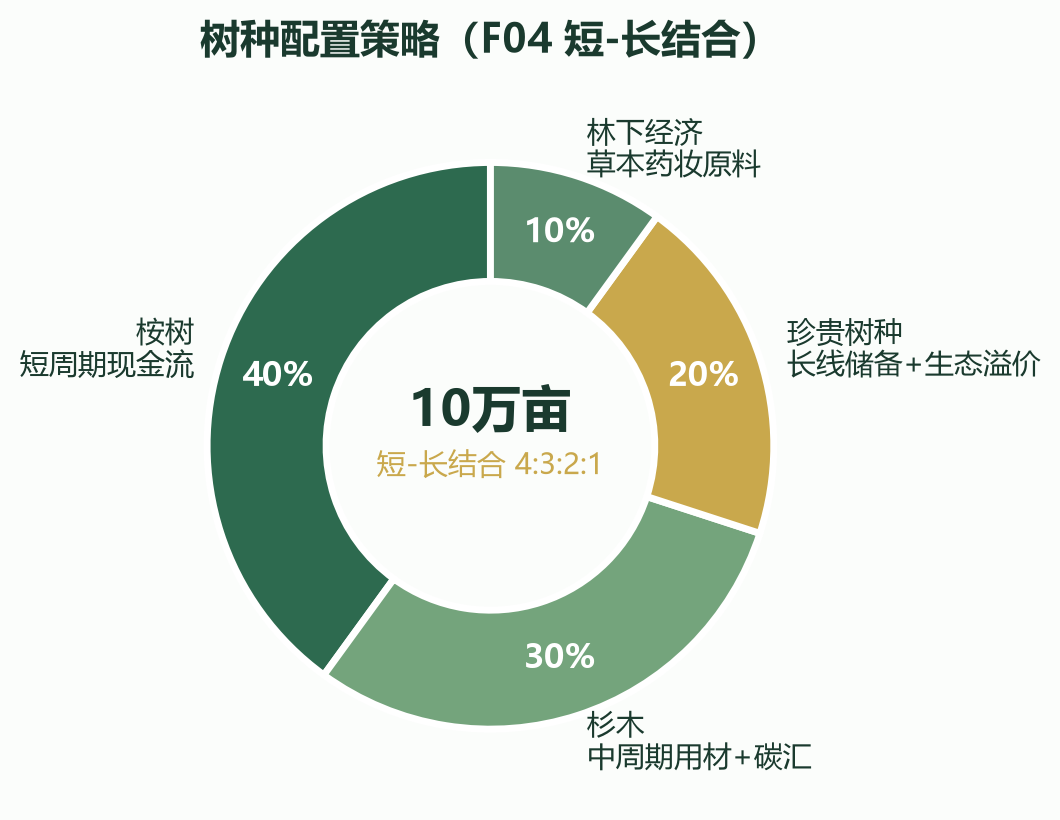
Figure 3 | Species mix and investment structure for a 100,000-mu forest
5.2 Layer One: Base Timber Income Anchored to the Exchange
This is the “floor price” of the Forest Coin — no matter how the secondary and tertiary industries perform, timber and carbon sink income are the certain, listable, exchange-anchorable base value.
| Income item | Basis of calculation | Annual per mu (RMB) | Annual total (RMB 10,000) |
| Eucalyptus timber | 40,000 mu × RMB 500/mu/year (5-year rotation, 75 m³/ha of merchantable timber, RMB 500/m³) | 200 | 2,000 |
| Chinese fir timber | 30,000 mu × RMB 533/mu/year (12-year rotation, 120 m³/ha of merchantable timber, RMB 800/m³) | 160 | 1,600 |
| Precious species | No short-term income counted (long-term reserve, monetized at high value after 30 years) | 0 | 0 |
| Carbon sink (CCER) | 0.2 tCO2/mu/year × RMB 70/t (carbon sink from commercial forest management) | 14 | 140 |
| Base total | approx. 374 | approx. 3,740 |
Over a 30-year operating cycle, the base layer yields average annual income of about RMB 37.4 million. Discounting at 5% to calculate the 30-year present value (assuming timber prices rise 2% a year):
30-year base-layer present value = RMB 37.4 million × annuity present value factor (5%, 30 years) × (1 + price growth adjustment) ≈ RMB 570 million
That RMB 570 million is the “base asset value” that can be listed and anchored on a forestry property rights exchange — it is the hard floor of the Forest Coin. Even if the secondary and tertiary industries all fail, even if the understory economy yields nothing at all, this RMB 570 million of timber + carbon sink value is certain, deliverable, and verifiable.
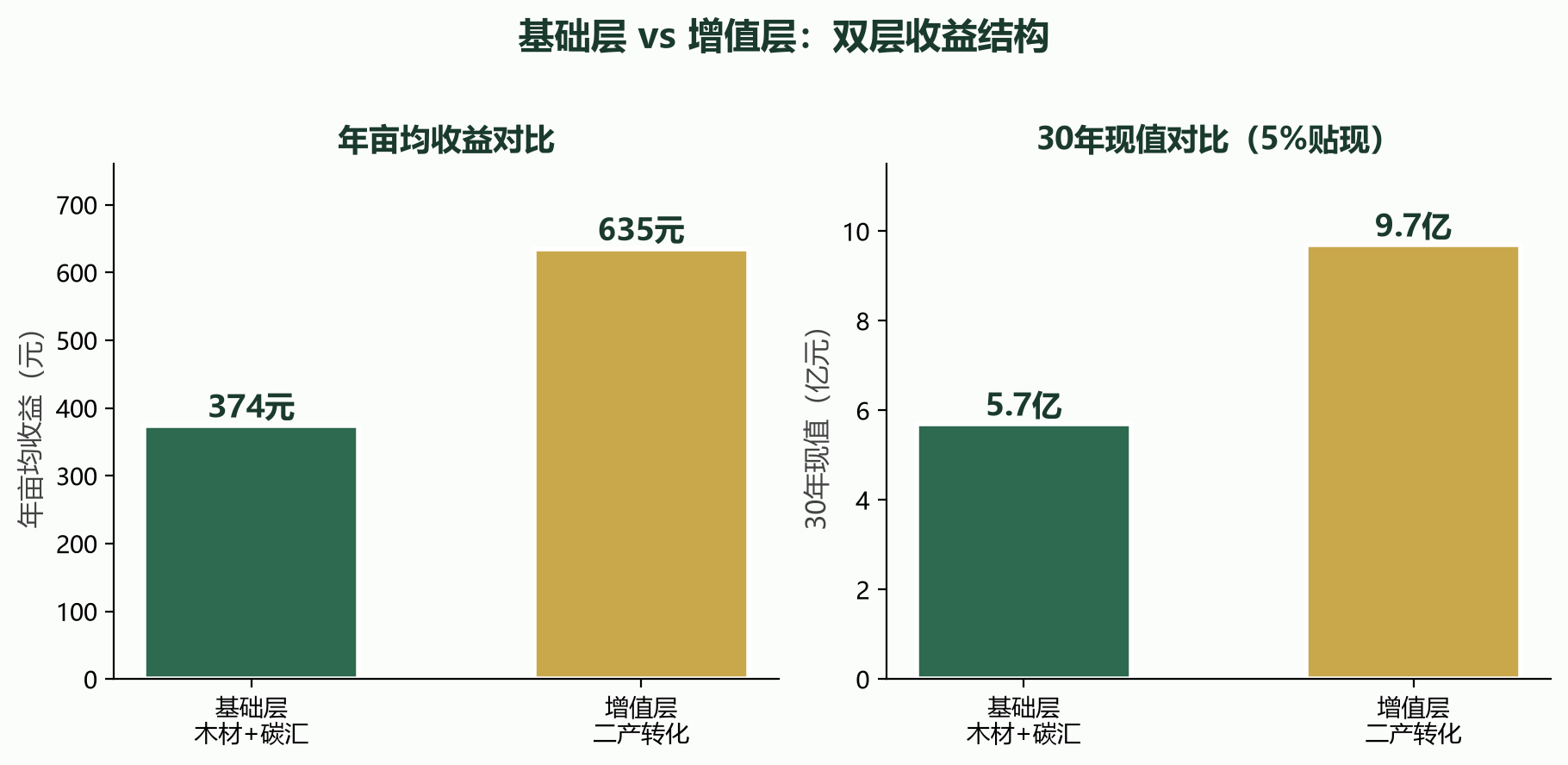
Figure 4 | The two-layer income structure: base layer (timber + carbon sink) and value-added layer (biomedicine · new materials)
5.3 Layer Two: Value-Added Income from Secondary-Industry Deep Processing
Now comes the part where “technology empowerment” (F05) does its work. Base timber is only raw material; the real profit is in deep processing — from “selling wood” to “selling molecules,” “selling medicine,” “selling new materials.”
(1) Understory herbaceous cosmeceutical raw materials (the 10,000-mu dedicated zone):
| Variety | Annual output value per mu | Annual total | Notes |
| Rosemary extract (carnosic acid) | RMB 1,500 | RMB 15 million | Natural antioxidant, food/personal care |
| Centella asiatica extract (asiaticoside) | RMB 1,200 | RMB 12 million | Active ingredient in skincare |
| Mint/lavender essential oil | RMB 800 | RMB 8 million | Aromatherapy/personal care fragrance |
| Subtotal | approx. RMB 1,200/mu | approx. RMB 35 million | Raw-material-grade income |
(2) Plant extract factory (5× value added):
The 10,000 mu of herbaceous cosmeceutical raw materials produce RMB 35 million in annual output value (raw-material grade). Building a plant extract factory (supercritical CO2 extraction + membrane separation and purification) to process the raw materials into standardized extracts adds 5× in value:
Extract-grade annual output value = RMB 35 million × 5 = RMB 175 million
(3) Biomedicine end products (10× value added):
The extracts are further converted into end products — skincare serums, functional foods, natural medicines for pets — and the end-product brand value can reach 10× that of the extracts. Using shrub ajania serum as a reference (the F05 case: 1,000 mu → 189,000 bottles), the extracts matched to 100,000 mu of forest land can support dozens of end-product lines.
Potential end-product annual output value = RMB 175 million × 10 = RMB 1.75 billion (potential market value)
But market development for end products takes time and channel building, and cannot be done in one step. Conservatively, calculating at 15% capture of end-product value, the income actually achievable is:
Actual annual biomedicine income ≈ RMB 1.75 billion × 15% = RMB 260 million
(4) Wood-based new materials (20,000 mu of precious species + harvesting residues):
Lignin-based phenolic resins (formaldehyde-free adhesives), nanocellulose (CNF/CNC), CLT cross-laminated timber, and so on. Allocated at RMB 2,000 per mu per year (using harvesting residues and processing waste):
Annual new-materials income = RMB 2,000 × 100,000 mu = RMB 200 million
Value-added layer total:
| Value-added item | Annual income | Notes |
| Extract factory | RMB 175 million | Raw material → extract, 5× value added |
| Biomedicine end products (15% capture) | RMB 260 million | Extract → end-product brand, 10× value added |
| Wood-based new materials | RMB 200 million | Lignin/nanocellulose/CLT |
| Value-added layer total | approx. RMB 635 million/year | i.e. approx. RMB 635/mu/year |
30-year value-added layer present value (5% discount, allowing for the higher value-added rate brought by technology iteration):
30-year value-added layer present value ≈ RMB 970 million
5.4 The Forest Coin Issuance Pricing Model
Now we have a complete asset valuation:
| Asset layer | 30-year present value | Nature | Exchange anchoring |
| Base layer (timber + carbon sink) | RMB 570 million | Certain income, hard floor | Listable on the forestry exchange |
| Value-added layer (secondary-industry conversion) | RMB 970 million | Operating income, highly elastic | Income-right certificate pledge |
| Total asset valuation | approx. RMB 1.54 billion | Future-income valuation | — |
Forest Coin issuance plan:
Following a conservative principle, take 70% of the total asset valuation as the issuance base (keeping a 30% safety margin), and issue 1.08 billion Forest Coins at an issue price of RMB 1 per coin.
| Parameter | Value | Notes |
| Total asset valuation | RMB 1.54 billion | Future-income valuation method (base layer + value-added layer) |
| Issuance base (70%) | RMB 1.08 billion | Conservative 30% discount |
| Total issuance | 1.08 billion coins | 1 coin = RMB 1 |
| Area per coin | approx. 0.93 square meters | 100,000 mu ÷ 1.08 billion coins |
| Underlying asset value per coin | approx. RMB 1.43 | RMB 1.54 billion ÷ 1.08 billion coins |
| Safety margin | 30% | Issue price RMB 1 < underlying value RMB 1.43 |
This means: an investor buys Forest Coins at RMB 1 per coin, while the underlying asset behind them is worth RMB 1.43 — the purchase comes with a 30% safety discount. Forest Coin holders enjoy the right to share in the income of the underlying forest asset (timber sales, carbon sink trading, dividends from extract factory profits, and so on), and the income is distributed proportionally and automatically through smart contracts.
Once listed on a forestry property rights exchange, the price of the Forest Coin will float with the growth condition of the underlying forest and with market supply and demand. Because the forest grows naturally every year (volume + carbon sink), even with no additional management at all, the underlying asset value grows by about 5–8% a year — this is the “natural appreciation” that sets the Forest Coin apart from every other stablecoin.
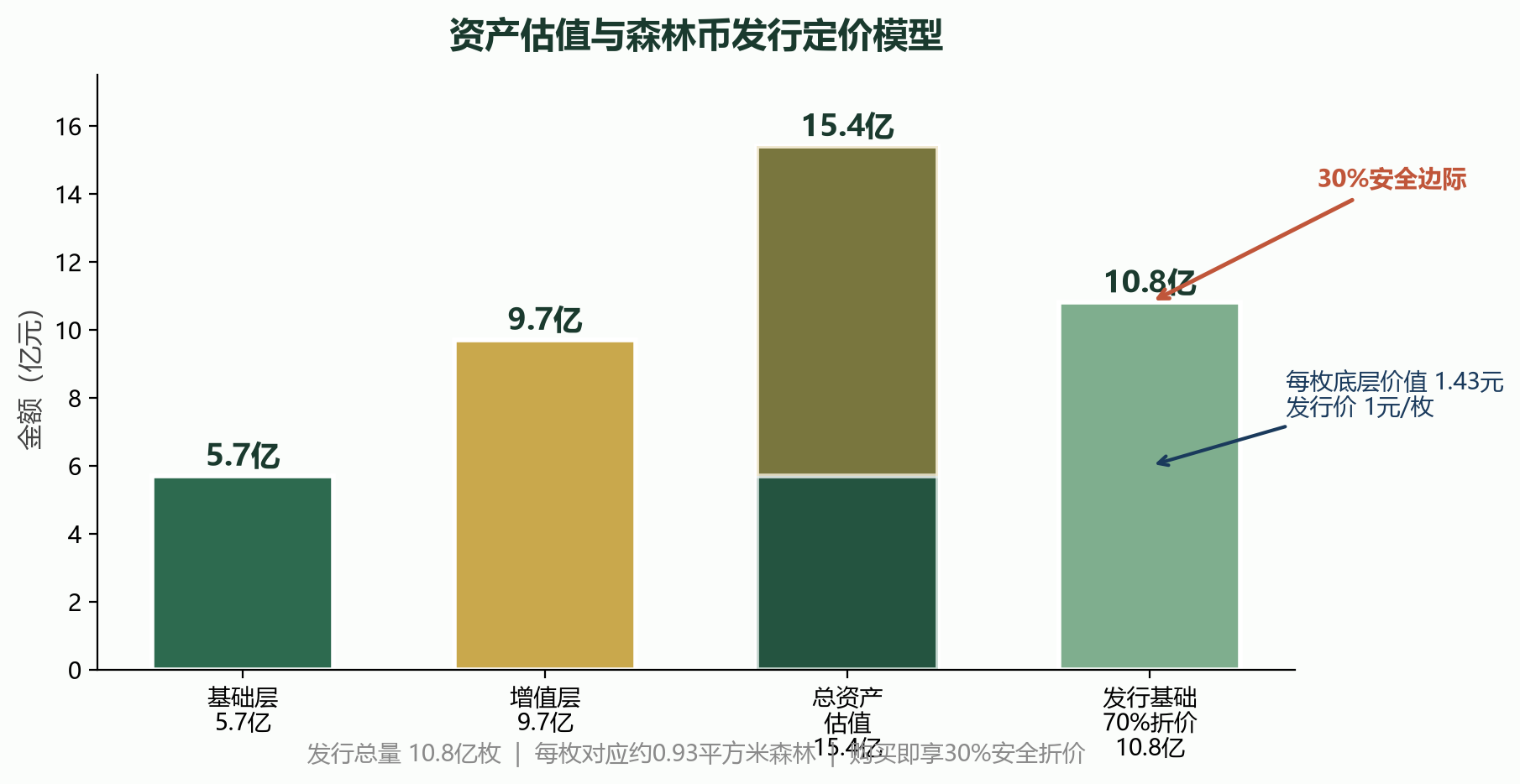
Figure 5 | Forest Coin issuance pricing: RMB 1.54 billion total valuation → 70% discount → issue 1.08 billion coins @ RMB 1
5.5 Case Summary: From 100,000 Mu to 1.08 Billion Forest Coins
Let us use one diagram to summarize the complete logic of this 100,000-mu case:
100,000 mu of forest → RMB 1 billion investment (RMB 600 million policy-based finance + RMB 400 million social capital) → base layer RMB 570 million (timber + carbon sink, exchange-anchored hard floor) + value-added layer RMB 970 million (extracts + biomedicine + new materials) → total asset valuation RMB 1.54 billion → conservative 70% discount → issue 1.08 billion Forest Coins @ RMB 1/coin → each coin’s underlying value RMB 1.43; the purchase comes with a 30% safety margin → the forest grows naturally 5–8% a year → the Forest Coin appreciates naturally
That is the complete conversion path of the Forest Coin from “a real forest” to “a tradable digital token.” Every step is supported by real industry; every layer has verifiable data. No air, no bubble — only trees growing and value accumulating.
6. From 100,000 Mu to the World: The Hundredfold Value Leap of the Forest Coin
The case in the previous chapter showed the pricing logic of the Forest Coin under the framework of “traditional forestry operations + secondary-industry conversion.” 100,000 mu of forest, RMB 1.54 billion valuation, 1.08 billion Forest Coins issued — this is visible, tangible “industrial value.”
But if you think that is where the value of the Forest Coin stops, you are underestimating it.
The real explosive power of the Forest Coin does not lie in how much timber or how many extracts it anchors, but in the fact that it builds a global, decentralized, self-reinforcing value network. When that network expands from “one 100,000-mu forest” to “millions of forests around the world,” the value of the Forest Coin will undergo one — or several — orders-of-magnitude leaps. Not a 10% gain, not a 100% gain, but a gain of a hundredfold or more.
This is not a pie in the sky. Let me break down, layer by layer, where this “hundredfold” comes from.
6.1 First Leap: Liquidity Premium (3–5×)
What is the biggest pain point of traditional forestry assets? Illiquidity. To sell a 100,000-mu forest farm, you have to find a buyer, get a valuation, transfer the title, change the forest tenure certificate — a process that takes months or even years, with transaction costs as high as 5–15% of asset value. That is why forestry assets have long been undervalued — not because they are worthless, but because they cannot be sold, and so they must be discounted.
The Forest Coin solves this problem completely. Each of the 1.08 billion Forest Coins is a divisible, tradable digital token, circulating 24/7 on global crypto asset exchanges. An investor does not need to buy an entire forest; he can spend RMB 100 on 100 Forest Coins and share in the forest’s appreciation.
Liquidity is itself value. Academic research shows that when an asset moves from “non-tradable” to “freely tradable,” it brings an average liquidity premium of 3–5× (the reversal of the illiquidity discount). After US timberland REITs (such as Weyerhaeuser and Rayonier) moved from directly owning forest land to being listed REITs, their valuation multiples rose from 8–10× P/FFO to 15–25× — that is the empirical evidence that liquidity restructures value.
1.08 billion Forest Coins, from “listing” to “free circulation”:
Valuation after liquidity premium = 1.08 billion × RMB 1 × 3–5 = RMB 3.24–5.40 billion
6.2 Second Leap: Network Effects (10–20×)
When it is not just you issuing Forest Coins but thousands of forest operators each issuing their own coins on the Forest Coin protocol, network effects (Metcalfe’s Law) come into play.
Metcalfe’s Law states that the value of a network is proportional to the square of the number of nodes. A telephone network with one user is worth nothing; with 100 users it is worth 10,000; with 100 million users it is worth 10 quadrillion.
The same goes for the Forest Coin network. When only one 100,000-mu forest is issuing Forest Coins, it is just a “digitized timberland REIT” — it has investors but no ecosystem. When 100 forests each issue coins, investors can compare, choose, and combine among different Forest Coins — a market begins to form. When 10,000 forests are issuing coins, the Forest Coin exchange becomes the world’s largest natural-asset trading platform — liquidity depth, price discovery efficiency, and risk-hedging tools all emerge. When 1 million forests are issuing coins — when every farmer on Earth who has planted a few hectares of trees is taking part — the Forest Coin network becomes the largest decentralized ecological governance system in human history.
By a conservative estimate under Metcalfe’s Law, when the Forest Coin network covers 100 million mu of forest worldwide (about 0.17% of global forest area) and reaches 10 million participating users:
Network effect valuation = base asset value × network coefficient (10–20) = the starting point of a hundredfold leap
Bitcoin’s market capitalization once rose from zero to more than USD 1 trillion, with no physical asset behind it — only algorithmic consensus and network effects. Behind the Forest Coin are real forests, growing forests, forests that can be monitored by satellite. If “air” can be worth USD 1 trillion on network effects alone, why can’t “forest”?
6.3 Third Leap: The Global Reserve Narrative (50–100×)
When the Forest Coin network is large enough (say, covering more than 1 billion mu of forest, with total asset valuation above RMB 1 trillion), when its monitoring system is transparent and trusted enough (space-air-ground integration + AI verification + on-chain attestation), and when its governance is decentralized enough (global DAO co-governance), the Forest Coin qualifies for the narrative of becoming a “global reserve asset.”
How much is a narrative worth? Look at gold. Industrial uses consume only about 10% of gold’s annual output; the remaining 90% of demand comes from “reserves” and “investment” — meaning that of gold’s USD 13 trillion market capitalization, at least USD 10 trillion is “narrative premium.” People buy gold not because it is useful, but because everyone believes it is valuable.
The same goes for the dollar. The dollar’s hegemony rests, in essence, on a narrative: “the whole world accepts the dollar.” How much is that narrative worth? It lets the United States borrow globally at extremely low interest rates and gives US financial institutions the “seigniorage” of global financial infrastructure — the present value of this “dollar narrative premium” is conservatively in the tens of trillions of dollars.
If the Forest Coin’s narrative is “a real, renewable, self-growing asset anchor owned in common by all humanity” — the strength of global consensus behind that narrative is no less than gold’s (because the forest is more useful than gold) and no less than the dollar’s (because the forest needs no nation’s endorsement).
After the narrative premium:
Forest Coin in the 100,000-mu case = RMB 1/coin × 100× narrative premium = RMB 100/coin
1.08 billion coins × RMB 100 = RMB 108 billion market capitalization (vs. RMB 1.54 billion of underlying assets = 70×)
And that is only 100,000 mu. What about 1 million mu? 10 million mu? 1 billion mu worldwide?
6.4 Fourth Leap: Interstellar Civilization Infrastructure (Beyond Quantification)
The last leap can no longer be quantified in numbers.
When humanity truly begins to colonize Mars, the first thing built will not be a mine but a greenhouse farm. When the first tree in that Mars dome takes root, it will become the “first interstellar forest” of human civilization’s expansion beyond Earth. And that tree — like every tree on Earth — is renewable, self-sustaining, and self-growing. It too can be titled, monitored, tokenized, and brought into the Forest Coin’s anchoring scope.
At that stage, the Forest Coin will anchor no longer merely “forest assets on Earth” but “the entire ecological infrastructure of carbon-based life civilization.” Its value equals “the total value of all plant ecosystems required for the continuation of human civilization.”
How much is that worth? I cannot calculate it. But I know one thing: as long as humans remain carbon-based life, as long as humans still need to breathe and eat, that value will never fall to zero.
That is the Forest Coin’s ultimate moat — it anchors not a particular forest, nor a particular nation’s credit, nor the scarcity of a particular commodity, but “the existence of carbon-based life itself.”
6.5 The Complete Path of the Hundredfold Leap
| Leap stage | Trigger condition | Valuation multiple | Valuation in the 100,000-mu case | Multiple |
| Issue price | 70% discount on base + value-added layer | RMB 1.0/coin | RMB 1.08 billion | 1x |
| Liquidity premium | Free circulation on exchanges | RMB 3–5/coin | RMB 3.2–5.4 billion | 3–5x |
| Network effects | 10 million users + 100 million mu connected | RMB 10–20/coin | RMB 10.8–21.6 billion | 10–20x |
| Global reserve narrative | 1 billion mu + global DAO co-governance | RMB 50–100/coin | RMB 54–108 billion | 50–100x |
| Interstellar infrastructure | Human civilization expands beyond Earth | Beyond quantification | — | ∞ |
This is why I say the value of the Forest Coin does not stop at “the visible returns from traditional planting, processing, and conversion.” Traditional income — timber, carbon sinks, extracts, biomedicine — forms the “floor price” of the Forest Coin, ensuring that it never falls to zero. But the “ceiling” of the Forest Coin depends on the scale of the network, the strength of consensus, and the boundaries of civilization.
A 100,000-mu forest has a traditional industrial valuation of RMB 1.54 billion. But when we bring it into the framework of a global forest governance community and give it liquidity, network effects, and a global reserve narrative, its value can leap to RMB 108 billion or more. This is not a bubble, because every layer of the leap is supported by real incremental value: liquidity comes from trading demand, network effects come from the growth of participants, and the reserve narrative comes from the formation of global consensus. And at the very bottom — those 100,000 mu of growing forest — is always there, growing thicker and taller every year, fixing carbon, dropping leaves to feed the soil.
Trees grow 5% a year — that is the floor of the Forest Coin. Network effects expand tenfold every year — that is the ceiling of the Forest Coin. And when the first tree beyond Earth takes root, the ceiling itself will grow a new ceiling.
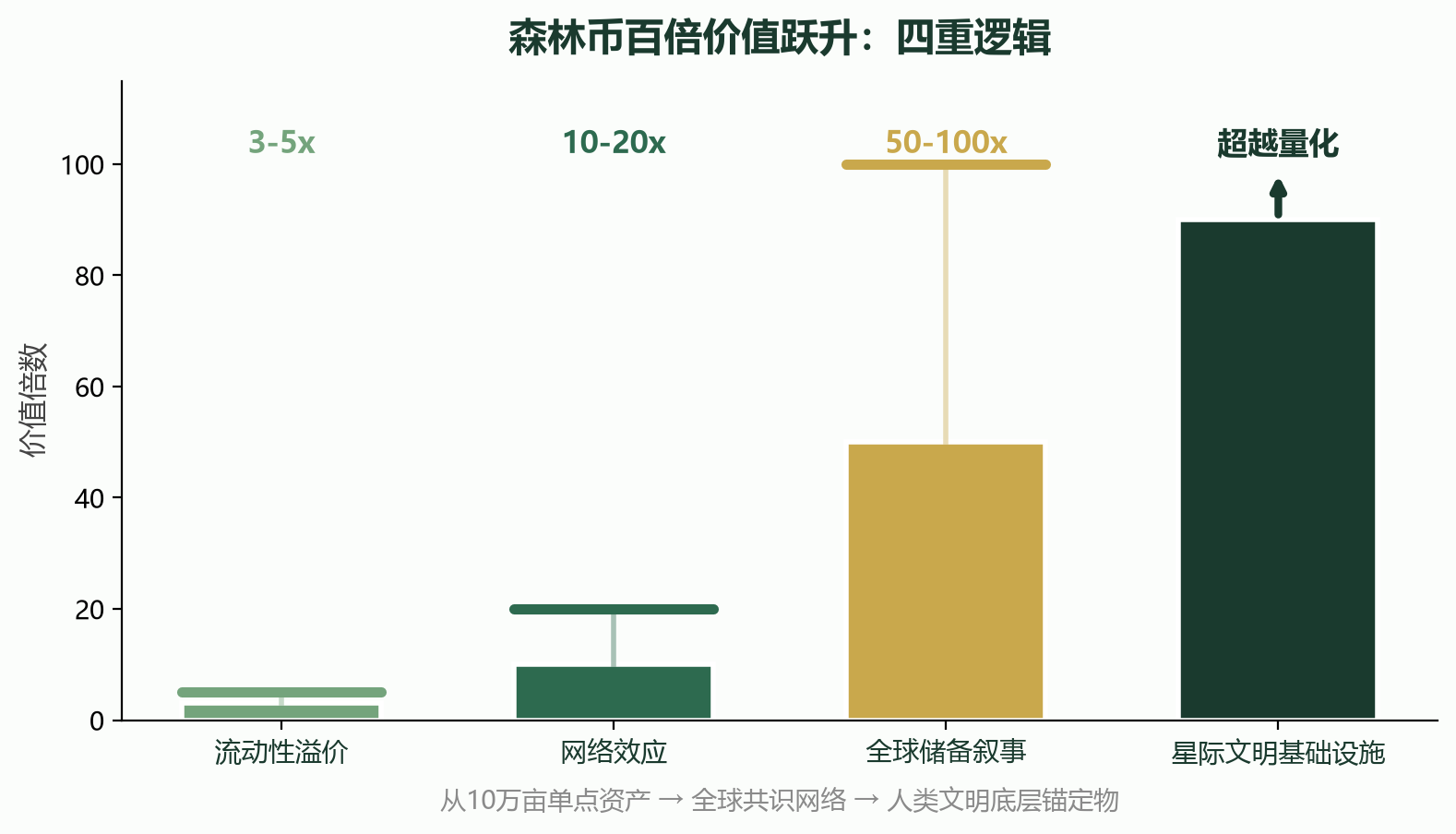
Figure 6 | The fourfold logic of the hundredfold value leap: liquidity premium → network effects → global reserve narrative → interstellar infrastructure
Conclusion: From F01 to F10, From Asset to Civilization
From F01’s “the forest is the greatest financial asset the universe has given humankind” to F10’s “exploring a forest asset monetization system,” these ten installments form a complete logical loop:
F01 established the forest’s asset attributes — it is a financial asset on the scale of a hundred trillion.
F02–F03 solved the liquidity problem — quantum division makes forest assets priceable and tradable, and separation of income rights lets the multiple incomes of a single forest be titled separately and circulate separately.
F04–F05 solved the operating problem — short-long combination means forestry investment no longer has to wait decades, and technology empowerment upgrades the forest from “selling wood” to “selling molecules,” “selling medicine,” and “selling new materials.”
F06 established the operating philosophy — protect through development, and use the returns to fund afforestation and forest protection.
F07–F08 solved the capital and circulation problems — policy-based finance leverages circular investment, and full-scope FSC certification opens up global markets.
F09 solved the fixed-income problem — creating stable, fixed-income forest financial products so that institutional investors have a reason to enter.
F10 completes the final jump — from “forest asset” to “forest currency” and then to “forest civilization.”
The essence of that jump is to turn the forest from “an object to be managed” into “the source of value”; to turn forest management from “an industry” into “the infrastructure of a civilization”; and to turn planting trees from “a kind of labor” into “a kind of power to issue currency.”
We know this road is long. Technically there is the engineering difficulty of space-air-ground integrated monitoring; institutionally there are the complex differences among countries in forest tenure law and financial regulation; in governance there is the long tug-of-war of forming a global consensus. But we also know the direction is right — because the forest’s renewability, self-sustaining capacity, and self-growth are the most precious attributes the Creator gave humanity, and the most trustworthy foundation for anchoring value.
Wherever humanity goes — as long as we are still breathing, we need the forest. And as long as we need the forest, we need a forest financial system in which all humanity manages, protects, and benefits together.
This is the original intention behind these ten installments, and the North Star of all our future practice.
Every tree we plant is a letter to the future. Every Forest Coin we issue is a promise to honor that letter. When forest covers the Earth and Forest Coins circulate the globe, we will prove at last — lucid waters and lush mountains are mountains of gold and silver; and those mountains of gold and silver can become the most solid foundation of human civilization.
*** END ***
Foreststellar · Perpetual Forest Management Series · July 2026